Written by Vendortell - the Contract Performance Management platform. We've watched Q4 renegotiations leak value on both sides - buyers and suppliers - because neither had the data ready.
Every Q4 the same pattern repeats.
Renegotiations stack up.
Legal, Procurement, Finance and Sales scramble.
Contracts sit in PDFs, inboxes and shared drives.
Teams negotiate without a full, trusted picture of what was agreed or what was delivered.
On the surface, it looks like a seasonal problem: “We are just busy in Q4.”
In reality, Q4 is a stress test that exposes something far more structural:
Most organisations do not treat contracts as financial assets. They treat them as documents.
The result is a predictable pattern of value leakage:
- Discounts and incentives that are never claimed.
- Automatic renewals that slip through at suboptimal terms.
- Missed rights and weak remedies when performance drops.
- Hours burned chasing information instead of negotiating outcomes.
What the research actually says
Vendortell is the Contract Performance Management platform. We manage EUR 100M+ in live contract value across 10,000+ contract books for CFOs, CPOs, and finance leaders - turning signed contracts into live financial truth.
That's why we can call out the Q4 leak pattern here - Vendortell exists to close the visibility gap that makes Q4 renegotiations a scramble.
Global research points to the same conclusion. Poor contract management erodes a significant share of revenue and margin.
Across studies by World Commerce & Contracting, KPMG, ProcurementTactics, Deloitte, Gartner, McKinsey and Forrester, the picture is consistent. Ineffective contracting typically erodes high single-digit to low double-digit percentages of annual contract value through leakage, missed entitlements, poor handovers and weak post-award governance.
- WorldCC finds that organisations lose around 9% of value annually through poor contract management, with best performers closer to 3% and laggards at 15% or more.
- KPMG and WorldCC report that almost 90% of organisations still operate with ineffective, fragmented contracting processes.
- ProcurementTactics estimates that 40% of leakage stems from process and follow-up failures, not from the initial negotiated deal.
- Gartner describes a shift from managing sourcing to orchestrating value across the full contract lifecycle.
- McKinsey shows how digital and AI capabilities can materially reduce leakage.
- Forrester now describes modern CLM as a bridge between strategy and reality, not just a document workflow tool.
Contracts cannot stay as static PDF archives. They must become structured, connected and intelligent.
Traditional CLM systems improve document workflows. They help you create, approve and store contracts. But they rarely connect those contracts to vendors, spend, incentives and real-world performance. That is where Q4 value is won or lost.
Contract intelligence is the missing link. It is the capability to understand what is inside the contracts, what it means for your P&L, and how to act on it before, during and after renegotiations. Vendortell exists for exactly that reason.
Q4 does not cause value loss - it exposes it
Most organisations experience Q4 as a pressure cooker. Renegotiations line up in parallel. Sales pushes to close. Procurement pushes to save. Legal fights the clock. Finance watches the P&L tighten. It feels like a yearly storm you just have to “get through”.
But the renegotiations themselves are not the real problem. The structure behind them is.
When Vendortell starts working with a new customer, we almost always see the same underlying issues:
- Contracts live as static PDFs across shared drives, emails and point tools.
- No single owner of post-award contract performance.
- Legal owns wording; Procurement owns price; Finance owns spend; Sales owns commitments.
- Incentives, bonuses and penalties are tracked in Excel, if at all.
- Operational knowledge sits in people’s heads rather than in a system.
This structure works “well enough” in a normal week. When Q4 hits, it breaks. Teams spend days asking the same questions:
- “Where is the latest version of this contract?”
- “Did we already use that rebate?”
- “What are we actually entitled to if performance drops?”
- “Who agreed to this clause, and why?”
The Q4 crunch reveals value leakage that has been accumulating all year: uplift clauses not triggered, benchmark and reprice rights left unused, volume rebates never claimed, performance issues not escalated.
The central shift in thinking is this: Q4 does not cause value loss. Q4 exposes the value loss caused by weak contract structures. To fix Q4, you need to fix the structure.
Traditional CLM vs contract intelligence
Most organisations have made progress in digitalising contracts. PDFs are stored in a CLM or DMS. Playbooks, templates and standard clauses are in place. E-signature is widely used. This is positive, but it is only the first step.
In a Q4 renegotiation, a static PDF in a CLM does not answer the questions a CFO or CPO actually cares about:
- “What is the total spend across all contracts with this vendor?”
- “Which incentives and protections do we have, and have we used them?”
- “Where are we overpaying against market benchmarks?”
- “What are the cross-dependencies with other agreements?”
Traditional CLM systems know where the contracts are and how documents are approved and signed. They rarely know:
- What is inside those contracts in a structured way.
- How those terms connect to invoices, performance and P&L.
- Which actions teams should take before Q4 to reduce risk or capture upside.
Traditional CLM improves document workflows. Contract intelligence connects those documents to vendors, spend and incentives, and that is where Q4 value is won or lost.
Contract intelligence means treating each contract as a structured, connected, living asset instead of a static document. In practice, that means:
- Extraction and structure. Key terms, prices, incentives, KPIs, durations, indexation, rights and obligations are automatically captured as data, not buried in text.
- Connection to reality. Contracts are linked to vendors, customers, categories, invoices, volumes and performance metrics.
- Visibility across the portfolio. Exposure and opportunity become visible not just per contract, but across categories, vendors, regions and business units.
- Action and workflows. Tasks, reminders and playbooks are triggered automatically when conditions are met (e.g. indexation window, minimum volume not met, performance below target).
- Analytics and AI. You can ask questions in natural language and get answers grounded in the actual contracts and contract data.
Instead of “a 32-page document that someone should read before the next negotiation”, you get “a living asset that continuously tells you where you are leaking value and what to do about it.”
The Contract Value Leakage Loop
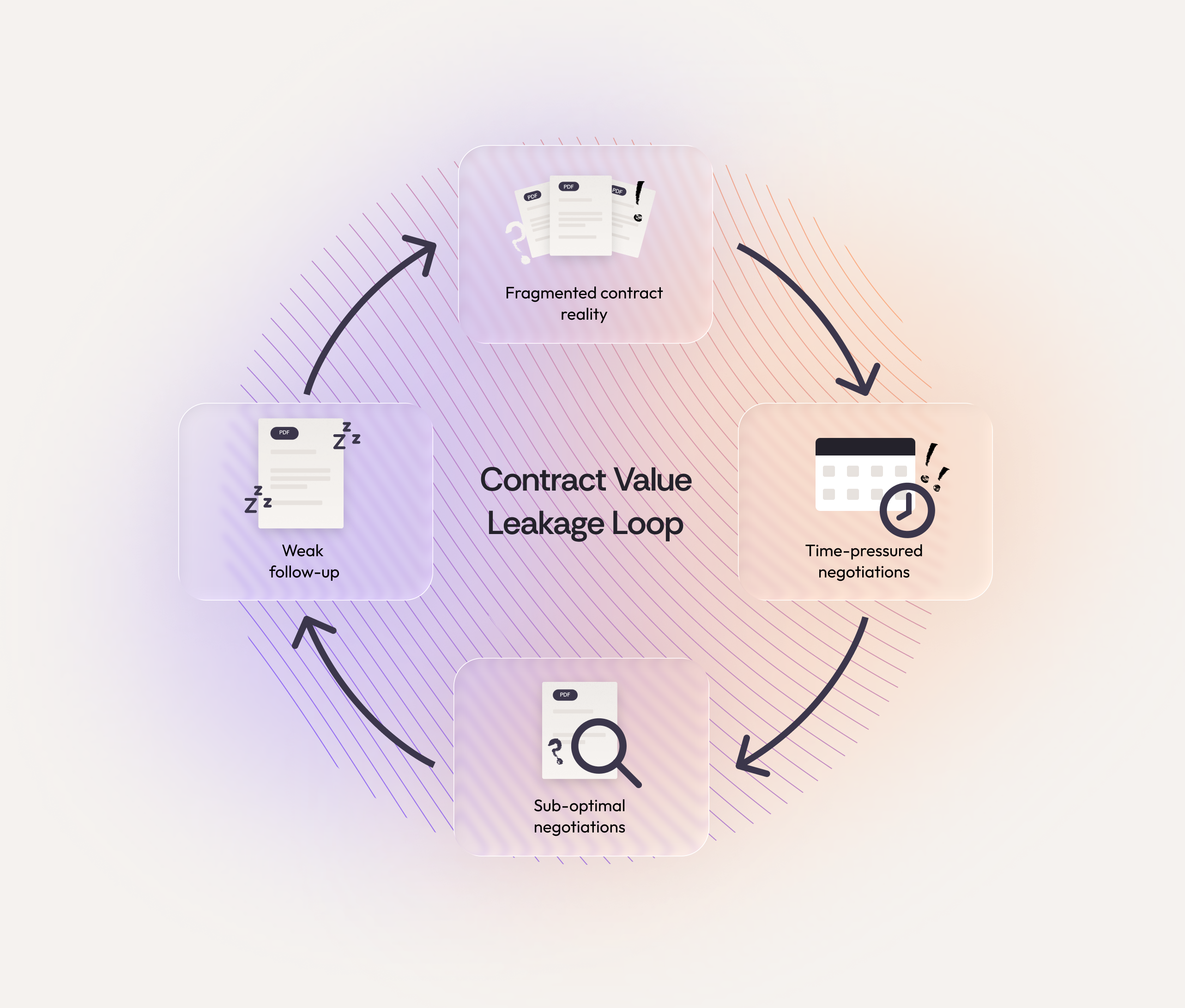
The Contract Value Leakage Loop describes the recurring pattern we see when contracts are treated as static documents and Q4 renegotiations are run on partial information. It has four steps:
- Fragmented contract reality. Contracts are scattered across systems, geographies and teams. Key terms are not structured. No one has a complete picture.
- Time-pressured renegotiations. Q4 hits. Renewals pile up. Teams do not have weeks to analyse each contract and vendor relationship properly.
- Sub-optimal negotiations. Negotiations are based on fragments: a PDF, a few invoices, someone’s memory. Upside and risk are missed.
- Weak follow-up. New agreements are signed, but incentives, obligations and risks are not tracked systematically. The next cycle starts with the same gaps.
Then the loop repeats.
Mini-case: from blind spots to seven-figure upside
Consider a European distributor with roughly €200m in annual third-party spend and more than 600 vendor contracts.
Before Vendortell:
- Contracts were in shared drives and a basic CLM.
- Incentives and rebates were tracked manually in spreadsheets.
- Q4 renegotiations relied on PDFs and local knowledge.
In their first 30 days with Vendortell, they:
- Centralised and structured about 150 of their largest vendor contracts.
- Linked incentives and pricing terms to actual invoice and volume data for those vendors.
- Surfaced over €1.2m in previously unclaimed or underused rebates and discounts, value that would otherwise have stayed invisible.
By the next Q4 cycle:
- Negotiation packs highlighted exactly where benchmark and reprice rights, volume scales and performance issues could be used.
- The organisation had moved from Level 1–2 (PDF chaos / basic CLM) to a solid Level 3 Contract Intelligence Backbone in the categories that mattered most.
The value did not appear because they suddenly negotiated “harder” in one quarter. It became visible because they broke the Contract Value Leakage Loop.
Breaking that loop requires two things: a spine that connects contracts to vendors, spend and incentives, and a maturity journey that moves you from PDF chaos to portfolio-level intelligence.
The Contract Intelligence Spine
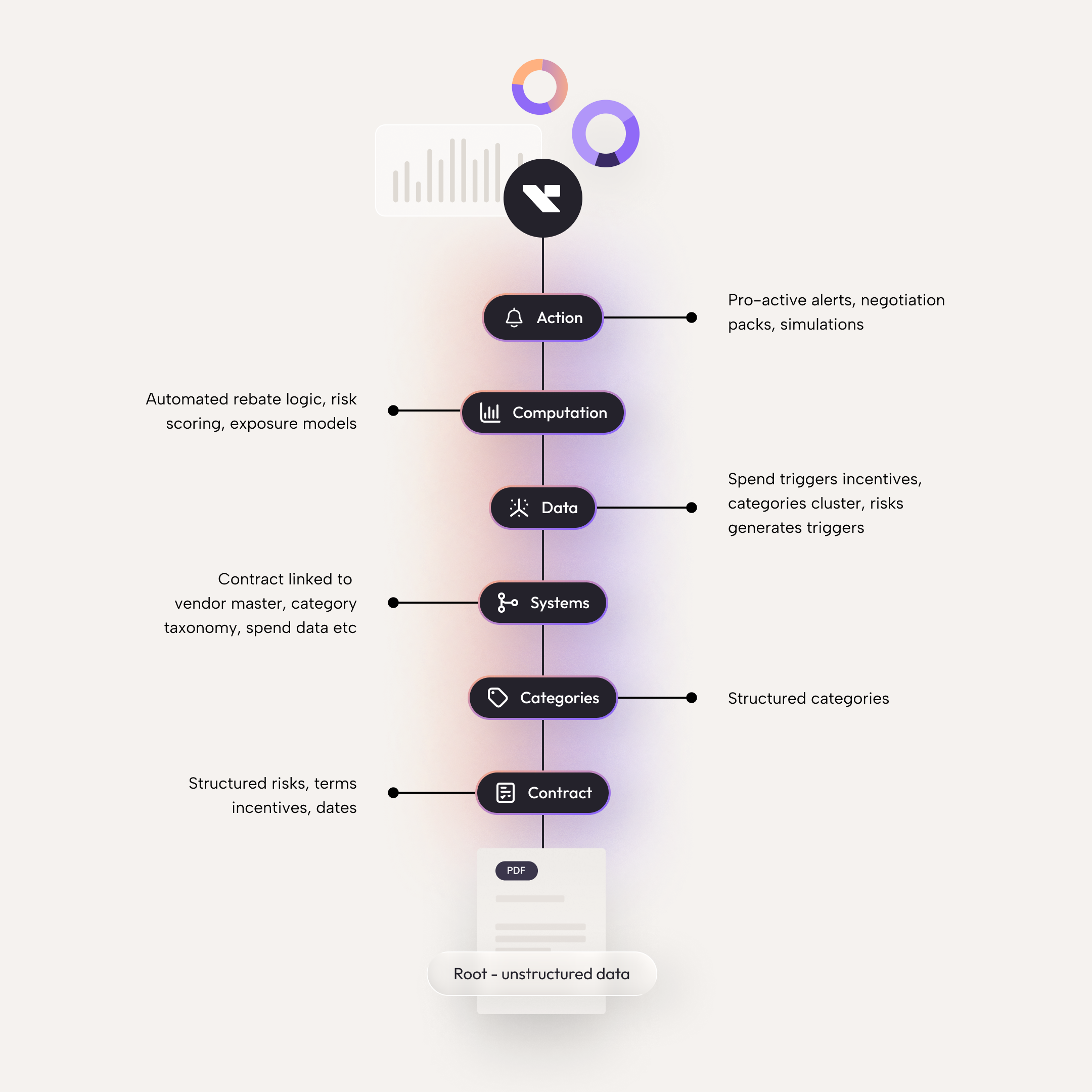
The Contract Intelligence Spine is the central backbone of your contract environment. It connects:
- Contracts
- Vendors and customers
- Spend and performance
- Incentives, risks and tasks
Traditional CLM sits at the document layer. The Contract Intelligence Spine sits at the value layer. Concretely, the spine does four things:
- Unifies data across vendors and customers. Vendor and customer records are the anchor. All contracts, addenda and related documents roll up into one consolidated view per relationship.
- Structures and indexes the contracts. Terms, pricing models, indexation, service levels, governance structures and incentives are extracted and normalised across contract types.
- Links to spend and performance. Contract data is connected with actual invoices, volumes and KPIs. You can see whether reality matches what was agreed.
- Drives workflows and decision-making. Tasks, approvals and renegotiation packs are generated based on contract data and upcoming events (price reviews, renewals, performance thresholds).
Vendortell is designed as a Contract Intelligence Spine from day one, not as yet another file cabinet.
The Contract Intelligence Maturity Curve
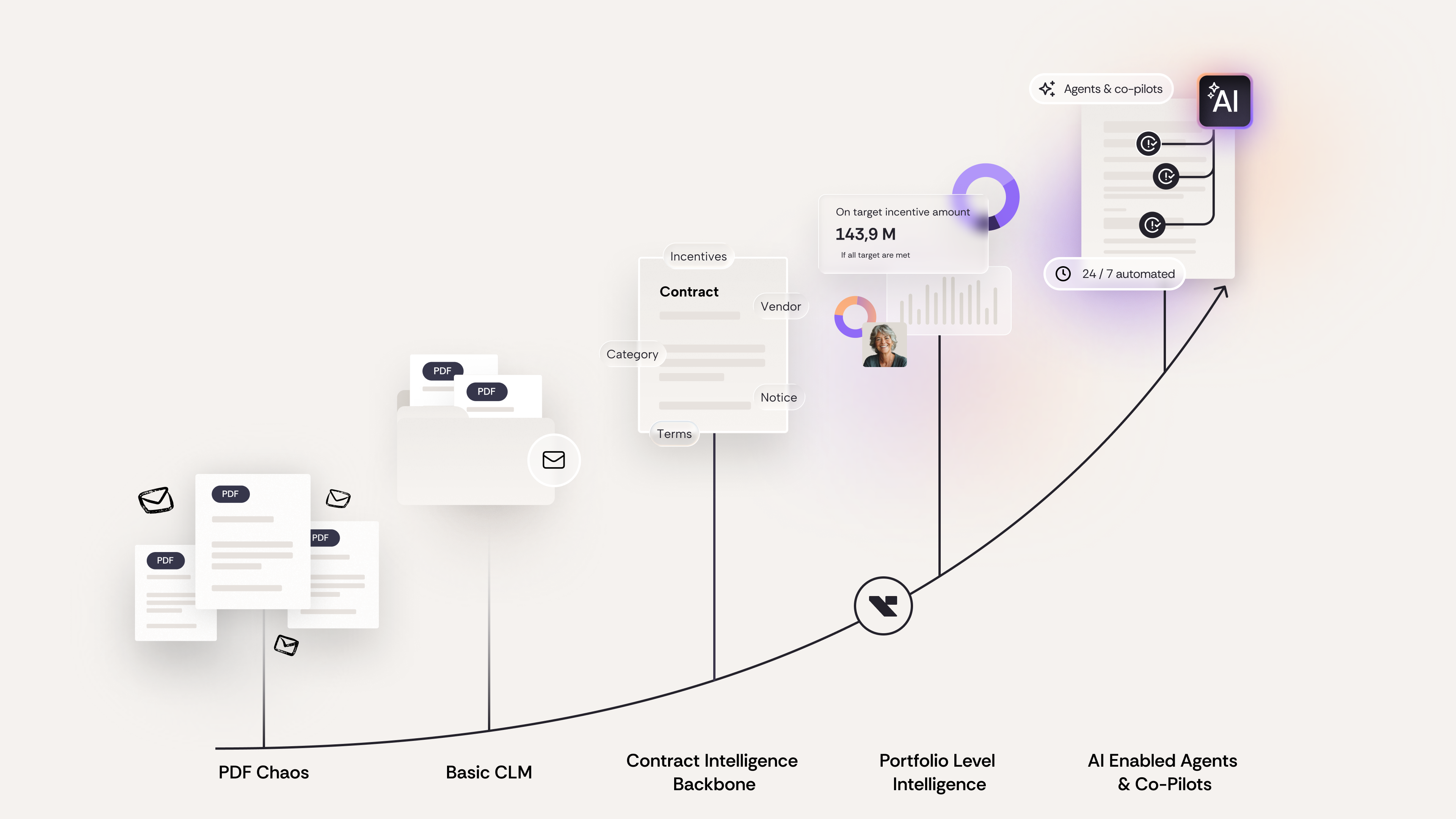
Most organisations underestimate how much structural value they lose as long as contracts remain static documents. The Contract Intelligence Maturity Curve describes five levels of maturity.
Level 1: PDF Chaos
- Contracts are stored as PDFs in shared drives and emails.
- No central overview of vendors, dependencies or incentives.
- Q4 renegotiations are driven by inbox searches and individual spreadsheets.
Level 2: Basic CLM
- Contracts are stored in a CLM with search, templates and e-signature.
- Expiry and renewal dates are tracked.
- Some metadata is captured, but often manually and inconsistently.
This is a step forward, but the economic reality of the contracts is still opaque. If your current CLM mainly answers “where is the contract?” and “when does it expire?”, you are at Level 2.
Level 3: Contract Intelligence Backbone
- Contracts are systematically structured and linked to vendors, customers and categories.
- Key terms, incentives, risks and obligations are extracted.
- Spend and performance data are connected where possible.
- Q4 renegotiation packs can be generated based on facts, not fragments.
Level 4: Portfolio-Level Intelligence
- You can see exposure and opportunity across the contract portfolio.
- Scenario analysis is possible: “What happens to our P&L if we renegotiate the top 20 vendor contracts by 2%?”
- Outliers, patterns and structural issues are surfaced automatically.
At Level 4, Q4 becomes a strategic exercise instead of a firefight. Vendortell is built to get organisations to the start of Level 4 quickly, always by leveraging existing contracts and systems rather than ripping everything out.
Level 5: AI-Enabled Agents and Co-Pilots
- AI agents continuously scan your contract and spend data for risks and opportunities.
- Agents proactively propose actions: “These five contracts should be repriced based on current indices” or “You are missing rebates for this vendor.”
- Agents can prepare negotiation packs, simulate scenarios and suggest alternative terms based on your playbooks and market input.
You do not have to jump from Level 1 to Level 5 overnight. But staying at Level 1–2 is now a strategic choice to keep leaking value. Vendortell is the practical way to move into Level 3–4 and to prepare for Level 5 safely.
How Vendortell delivers contract intelligence
Vendortell brings together vendor and customer management, contract management, incentives, tasks and analytics in one platform.
One backbone for vendors and customers
- Each vendor and customer has a single, shared profile across the organisation.
- All contracts, addenda and related documents are linked to that profile.
- Ownership is clear: you can see who is responsible for each relationship.
Contract management with real intelligence
Vendortell does not just store PDFs. It:
- Extracts and structures key terms based on document type.
- Links each clause or concept back to the exact place in the source contract.
- Creates summaries that non-legal stakeholders can understand and act on.
This means:
- Procurement sees negotiated incentives and how they are actually used.
- Finance sees exposure, indexation mechanisms and commercial risks.
- Legal sees how standard and non-standard clauses are distributed across the portfolio.
Incentive management
- Volume bonuses, rebates, penalties and performance based incentives are captured as data.
- Vendortell can track whether conditions are met and whether the incentive has been claimed.
- Upcoming opportunities and risks are surfaced proactively.
For many customers, this is where significant “hidden” upside is found.
In categories with high spend and complex incentives, it is common to uncover six- to sevenfigure value in the first year, not by renegotiating harder, but by finally seeing and using what was already agreed.
Task and workflow management
- Indexation windows, renewal deadlines and governance obligations trigger tasks automatically.
- Crossfunctional workflows ensure Legal, Procurement, Sales and Finance are aligned on renegotiation strategy and approvals.
- Nothing is left to memory or individual spreadsheets.
Analytics and portfolio views
- Dashboards give CFOs and CPOs a portfoliolevel view of spend, exposure and opportunities.
- Outliers and structural issues are highlighted: Non-standard clauses, off- benchmark pricing, underused incentives.
- Q4 preparation becomes a guided, datadriven process.
“Ask Vendortell”
- Natural-language search lets users ask questions directly:
- “Show me all contracts with autorenewal in the next six months over €100k.”
- “Which vendor contracts include rebate">volume rebates we have not used?”
For CFOs
- Contracts become visible financial assets rather than opaque obligations.
- You can see where value is leaking and where upside exists across the portfolio.
- Q4 renegotiations are aligned with P&L goals, not just local firefighting.
For CPOs and Procurement
- You gain a single source of truth for vendor agreements, incentives and performance.
- Negotiation leverage increases, because you know your entitlements and alternatives.
- You can orchestrate value across categories rather than renegotiating in isolation.
Forrester writes about contract inefficiencies and illustrates how fragmented storage, poor visibility and manual workflows drain time and value from procurement and legal teams.
Exactly the types of issues Vendortell addresses at scale. (Link #18)
For Legal
- Contract standards are enforced through structured templates and clauses.
- Deviations are visible at portfolio level, not discovered by accident.
- Legal can focus on high-risk, high-value work instead of chasing PDFs.
For Sales and Commercial leaders
- Customer commitments, SLAs and incentives are clear and searchable.
- Renewals can be planned as strategic value discussions, not last minute discounts.
- Upsell and crosssell opportunities hidden in existing agreements become visible.
For the Board
- There is a clear, databacked answer to the question:
- “How well are we managing the value and risk in our contracts?”
Forrester’s CLM landscape work underlines that modern CLM and, by extension, contract intelligence platforms now support executives across procurement, legal, tech and risk in turning contracts into an enterprise-level control and value lever. (Link #19 and Link #20)
Implementation roadmap
You do not have to transform everything at once. A phased approach typically looks like this:
- Stabilise and centralise. Consolidate contracts into Vendortell. Establish the vendor and customer backbone. Capture basic metadata (counterparty, value, dates, category).
- Structure the critical categories first. Focus on the vendor and customer segments with the highest spend and impact. Extract and structure key terms, incentives and risks. Connect to relevant spend and performance data.
- Build Q4 renegotiation packs. Use Vendortell to generate fact-based briefing packs for upcoming renegotiations. Align Finance, Procurement, Legal and Sales on objectives and walk-away points. Capture outcomes back into the system.
- Scale to portfolio-level intelligence. Extend structure and connections across more categories and regions. Build dashboards and alerts for executives. Systematically break the Contract Value Leakage Loop.
- Prepare for AI agents and co-pilots. Once your Contract Intelligence Spine is in place, start experimenting with AI-driven analysis and suggestion. Define guardrails, playbooks and risk policies. Let AI agents augment, not replace, your teams.
The key is to start where it matters most, prove value quickly and then scale.
Contracts are among the most valuable, yet least digitised assets in modern organisations. Q4 renegotiations do not create this reality, they simply shine a light on it.
Traditional CLM has taken organisations part of the way by digitalising documents and workflows. But as long as contracts remain static PDFs, you will keep negotiating on fragments instead of facts, leaving incentives and protections unused, and discovering risks and opportunities too late.
If you walk into Q4 without a Contract Intelligence Spine, you are choosing to leak value.
Vendortell gives you a different option: turn your contract landscape into a living, AI-ready financial asset, break the Contract Value Leakage Loop, and move up the Contract Intelligence Maturity Curve, from PDF chaos to portfolio-level control and, ultimately, AI-enabled optimisation.
A concrete next step. You do not need a multi-year transformation project to see if this works. Pick one strategic spend category or your top 20 vendor contracts. Bring them into Vendortell. In 30–60 days, measure how much previously invisible value, risk and opportunity we surface. From there, you decide how far and how fast to scale.
Stop losing value in silence. Start treating contracts as the financial assets they really are.