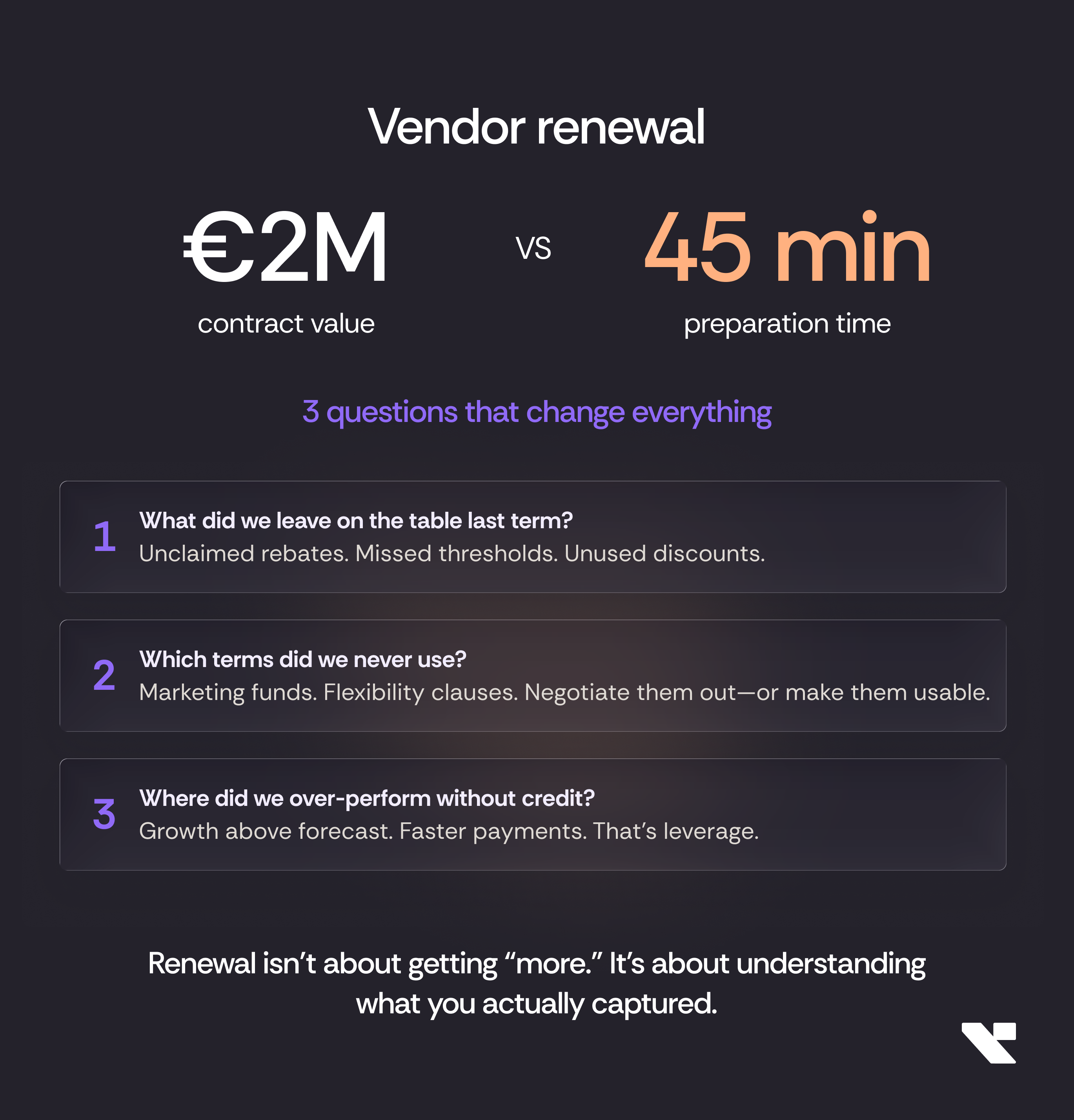
The problem is clear: Most CFOs and Procurement leaders walk into vendor renewals without knowing what value they left on the table. They don't know which rebates went unclaimed. They don't know how close they came to the next tier. They don't know which contract rights they never exercised.
Your vendor knows all of this. That information asymmetry costs you 10-15% in every negotiation. These three questions change that dynamic.
Question 1: What Incentives Did We Earn But Never Claim?
This is the €200K question most finance teams never ask.
Every vendor contract contains incentive structures: volume rebates, growth bonuses, early payment discounts, marketing development funds. You negotiated them. Your procurement team fought for them. But here's what we see in 73% of the vendor relationships we audit:
- Volume rebates worth €45K-€180K sitting unclaimed because no one tracked quarterly thresholds
- Growth bonuses of 2-4% that expired because the claim window was 30 days - and Finance didn't know
- Early payment discounts of 1.5-2% systematically missed because AP operates on a 45-day cycle
- Marketing development funds of €25K-€75K that require documentation your team never submitted
A CFO at a €400M manufacturer told us: "We found €127K in unclaimed rebates from a single vendor over three years. The money was ours. We just never asked for it."
Before your next renewal, pull every incentive clause from your current contract and match it against your actual claims. The gap between earned and claimed is money you're leaving with your supplier.
Question 2: Which Thresholds Did We Miss - And By How Much?
Near-miss analysis is the most underused negotiation tool in procurement.
Here's a scenario we see constantly: Your contract has a tier structure. Spend €1M annually, get 3% rebate. Spend €750K-€999K, get 1.5%. You spent €953K. You missed the higher tier by €47K - less than 5% - and left €15K on the table.
Now multiply this across every vendor with tiered pricing:
- The logistics provider where you were €62K short of the volume discount tier
- The raw materials supplier where combining two business units would have cleared the threshold
- The software vendor where a 13-month contract instead of 12 would have qualified you for annual pricing
This data changes your renewal conversation entirely. Instead of "we'd like better pricing," you say: "We were €47K short of your €1M tier last year. We're projecting €1.1M this year. Here's how we want to restructure the tiers."
For procurement teams: Build a threshold proximity report for every major vendor. Show exactly where you landed relative to every pricing tier, rebate level, and volume discount. That document is worth more than any negotiation training.
Question 3: What Contract Rights Have We Never Exercised?
You have more leverage than you think. It's buried in Section 14 of your agreement.
Most vendor contracts include protective clauses that procurement teams negotiated and then forgot. Rights that sit unused for the entire contract term:
- Price protection clauses: If the vendor offers better terms to a similar customer, you get matched pricing. Have you ever asked for the match?
- Audit rights: You can verify you're being charged correctly. When did you last exercise this? One client found €89K in billing errors in a single audit.
- Performance remedies: SLA breaches that entitle you to credits or penalties. Are you tracking and claiming these systematically?
- Benchmarking provisions: Rights to compare pricing against market rates. This alone can justify a 5-15% reduction.
- Technology refresh requirements: Obligations for the vendor to upgrade systems or provide newer versions at no cost.
A procurement director at a €600M company discovered their IT vendor had violated SLA terms 23 times in two years. Total potential credits: €156K. Total credits claimed: €0.
Before renewal, conduct a rights inventory. List every protective clause in your contract. Document whether you've exercised it - ever. Unused rights are negotiating currency you've already paid for.
Why These Questions Matter Before Renewal
Information asymmetry is killing your negotiating position.
Your vendor knows exactly how much you've spent, which thresholds you've hit, what incentives you've claimed, and which rights you've exercised. They have dashboards tracking your every transaction. They know your patterns better than you do.
And they're counting on you not having the same visibility.
When you walk into a renewal meeting without answers to these three questions, here's what happens:
- The vendor proposes a 3% increase "due to market conditions"
- You counter with "can you do better?"
- They offer 1.5% as a "valued customer" discount
- You accept, thinking you negotiated well
Best-in-class procurement teams operate differently. They enter renewals with:
- Documentation of €127K in unclaimed incentives over the contract term
- Analysis showing they missed two rebate tiers by less than 5%
- A list of 14 SLA breaches with €89K in unclaimed credits
- Benchmarking data showing they're paying 12% above market
That's not a negotiation. That's a restructuring conversation. And it starts with asking three questions your vendor hopes you never think to ask.
Preparing for Your Next Renewal
Here's your 120-day renewal preparation timeline.
120 Days Before Renewal:
- Pull the complete contract and all amendments
- Create an incentive inventory: every rebate, bonus, discount, and fund
- Request your complete transaction history from the vendor
- Identify all threshold structures and tier requirements
90 Days Before Renewal:
- Match earned incentives against claimed incentives - document every gap
- Calculate threshold proximity for every tier you didn't reach
- Build your "near-miss" analysis with specific euro amounts
- Gather market benchmarking data for your spend categories
60 Days Before Renewal:
- Conduct rights inventory - list every protective clause and its usage history
- Document all SLA breaches and unclaimed remedies
- Prepare your counter-position with specific financial evidence
- Model scenarios: What if we consolidated volume? Extended term? Added services?
30 Days Before Renewal:
- Present findings to internal stakeholders
- Align on negotiation objectives and walk-away points
- Schedule vendor meeting with CFOs and Finance Directors present
- Prepare documentation package for the negotiation
The vendors who get the best terms aren't better negotiators. They're better prepared. These three questions - and the work to answer them - are what separate the companies leaving €200K on the table from the ones who capture it.