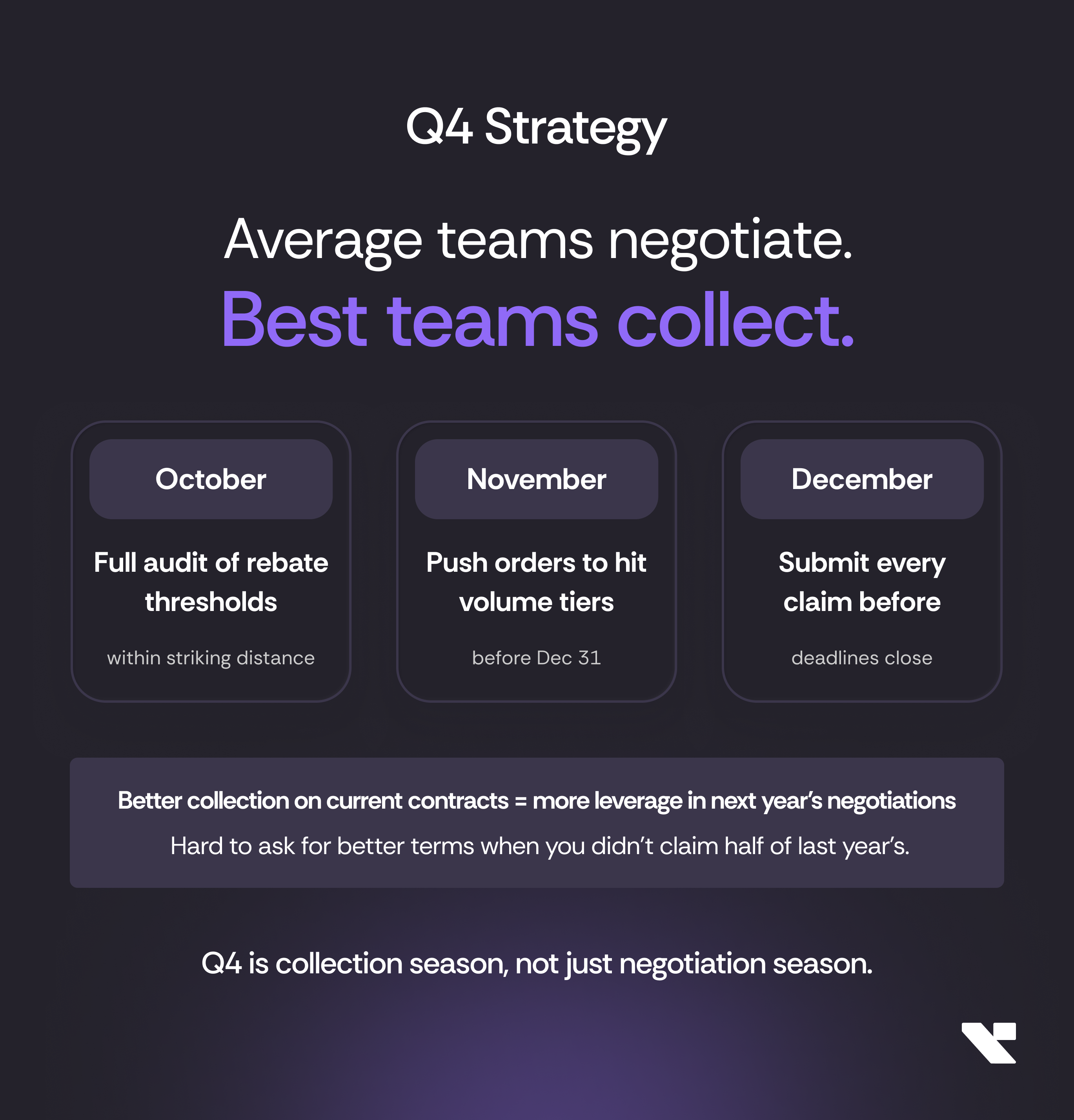
The Q4 Divide: Collectors vs. Negotiators
There are two types of procurement organizations in Q4.
Type 1: The Negotiators
Focus: Next year's contracts
- Calendar full of renewal meetings
- Drafting RFPs and reviewing proposals
- Negotiating new terms for January start
- Current year contracts? "We'll reconcile in January"
Type 2: The Collectors
Focus: This year's value
- October: Threshold audit across entire portfolio
- November: Strategic purchasing to hit remaining tiers
- December: Systematic claim submission
- January: Enter negotiations with clean claim history
According to Aberdeen Group research, best-in-class companies achieve a 56% higher contract renewal rate compared to their peers. That gap isn't about negotiating skill - it's about execution discipline.
You can't negotiate effectively while leaving current money uncollected.
The October Audit: Finding Money Before It Expires
Best-in-class procurement teams start Q4 with a comprehensive threshold audit.
The October Questions:
- Which rebate thresholds are we within 15% of hitting?
At €850K YTD spend with a €1M tier? That's a target, not a hope. - What claim windows close before year-end?
Annual rebates with December 31 deadlines. Quarterly bonuses with January cutoffs. - Which early payment discounts are we not taking?
2/10 net 30 terms that AP is ignoring because nobody told them. - What growth bonuses have we triggered but not documented?
YoY increase above 10%? That's often worth an additional 1-2%.
According to World Commerce & Contracting, organizations lose an average of 9% of contract value through poor management. The October audit is about finding that 9% before December 31.
You can't collect what you haven't identified.
The November Push: Strategic Purchasing for Value
November is about execution - turning threshold proximity into threshold achievement.
The November Tactics:
Accelerate Planned Purchases
Q1 purchases that could happen in December? Move them forward.
The math: If you're at €920K with a 3% tier at €1M, pulling forward €80K in January purchases earns you €30K in rebate (3% on €1M) vs. €27.6K (3% on €920K).
That €80K acceleration earns €2,400 extra. Cost: zero.
Consolidate Split Spending
Three business units buying from the same supplier? Consolidate for threshold purposes.
€300K + €350K + €400K separately = no tier hit.
€1.05M consolidated = tier 2 achieved.
Early Payment Window Capture
2% discount for payment in 10 days vs. net 30? On €500K in November invoices, that's €10K in free money.
But AP needs to know which invoices qualify. November is when procurement communicates.
McKinsey research shows that organizations practicing proactive contract management capture 3-5% more value than reactive organizations. November is where proactive happens.
The December Deadline: Claims Before Close
December is the finish line. Every unclaimed rebate, every unused right, every unexpired deadline - December is when it either gets captured or gets lost.
The December Checklist:
Rebate Claims Submitted
Every earned rebate documented and submitted:
- Volume thresholds achieved → claim filed
- Growth bonuses triggered → calculation submitted
- Product mix targets met → documentation complete
Performance Credits Claimed
Supplier underperformance during the year? SLA misses? Delivery failures?
December is when those credits get claimed - before they expire.
Expiring Rights Exercised
Price benchmarking rights that expire at year-end?
Renegotiation windows that close on December 31?
Use them or lose them. December is the last chance.
Next Year Foundations Set
Clean documentation of:
- Total available vs. total claimed
- Capture rate by supplier
- Missed opportunities and why
This becomes leverage for January negotiations.
Why Collection Beats Negotiation for Leverage
Here's the counterintuitive truth: better collection improves your negotiating position.
The Supplier's Perspective:
When you sit down to renegotiate, your supplier knows exactly what they paid you last year. They have the data.
- If your claim rate was 60%, they know they have a 40% buffer built in
- If your claim rate was 95%, they know you're tracking
Different conversations entirely.
The Data Advantage:
Walking into negotiations with:
- Complete claim history for the past 3 years
- Total available vs. total captured
- Specific missed thresholds and by how much
- Performance data matched to contract terms
That's not just information. That's leverage.
"We hit 94% of available rebates. We want terms that make it 100%."
vs.
"We want better rebates." "How much did you claim last year?" ". We're not sure."
Industry research confirms: 40% of contract value leakage stems from execution failures, not negotiation failures. Fix execution first, then negotiate from strength.
The Q4 Playbook: Week by Week
October Week 1-2: Portfolio Audit
- Pull all supplier contracts with incentive structures
- Map current YTD spend against all thresholds
- Identify "within striking distance" opportunities
- Flag all December 31 / Q4 claim deadlines
October Week 3-4: Action Planning
- Calculate threshold gaps and purchase requirements
- Coordinate with business units on Q1 pull-forward potential
- Brief AP on early payment discount priorities
- Assign claim preparation ownership
November Week 1-2: Execution Start
- Release accelerated purchase orders
- Begin rebate claim documentation
- Track threshold progress weekly
- Escalate any blockers
November Week 3-4: Documentation Push
- Complete all claim calculations
- Gather supporting documentation
- Pre-submit where suppliers allow
- Final threshold gap assessment
December Week 1-2: Submission Deadline
- Submit all rebate claims
- File performance credit claims
- Exercise expiring rights
- Document everything for January negotiations
December Week 3-4: Clean-Up and Prep
- Verify claim receipts
- Compile year-end capture report
- Build negotiation data packages
- Set Q1 collection calendar
The Metrics That Matter
Best-in-class procurement tracks Q4 differently.
Average Procurement Metrics:
- Cost savings negotiated
- Number of contracts renewed
- Cycle time to signature
Best-in-Class Q4 Metrics:
- Capture Rate: Rebates claimed ÷ rebates available
- Threshold Achievement: Tiers hit ÷ tiers within reach
- Claim Timing: Average days before deadline submitted
- Value at Risk: Unclaimed value with approaching deadlines
According to Gartner research, leading procurement organizations have moved from "savings" metrics to "value capture" metrics - measuring what's actually collected, not what's theoretically negotiated.
The shift:
Stop measuring what you negotiated. Start measuring what you captured.
What's Your Q4 Collection Plan?
If you don't have one, start with this:
List every rebate threshold you're within 10% of hitting.
If you can't generate that list in 30 minutes, you have a visibility problem.
If you can generate it but no one is acting on it, you have an execution problem.
If you're acting on it but still missing claims, you have a systems problem.
Best-in-class procurement doesn't happen by accident.
It happens because someone decided that Q4 is collection season - and built the processes, assigned the ownership, and tracked the metrics to make it real.
Average teams negotiate in Q4.
The best ones collect.
Which one are you?