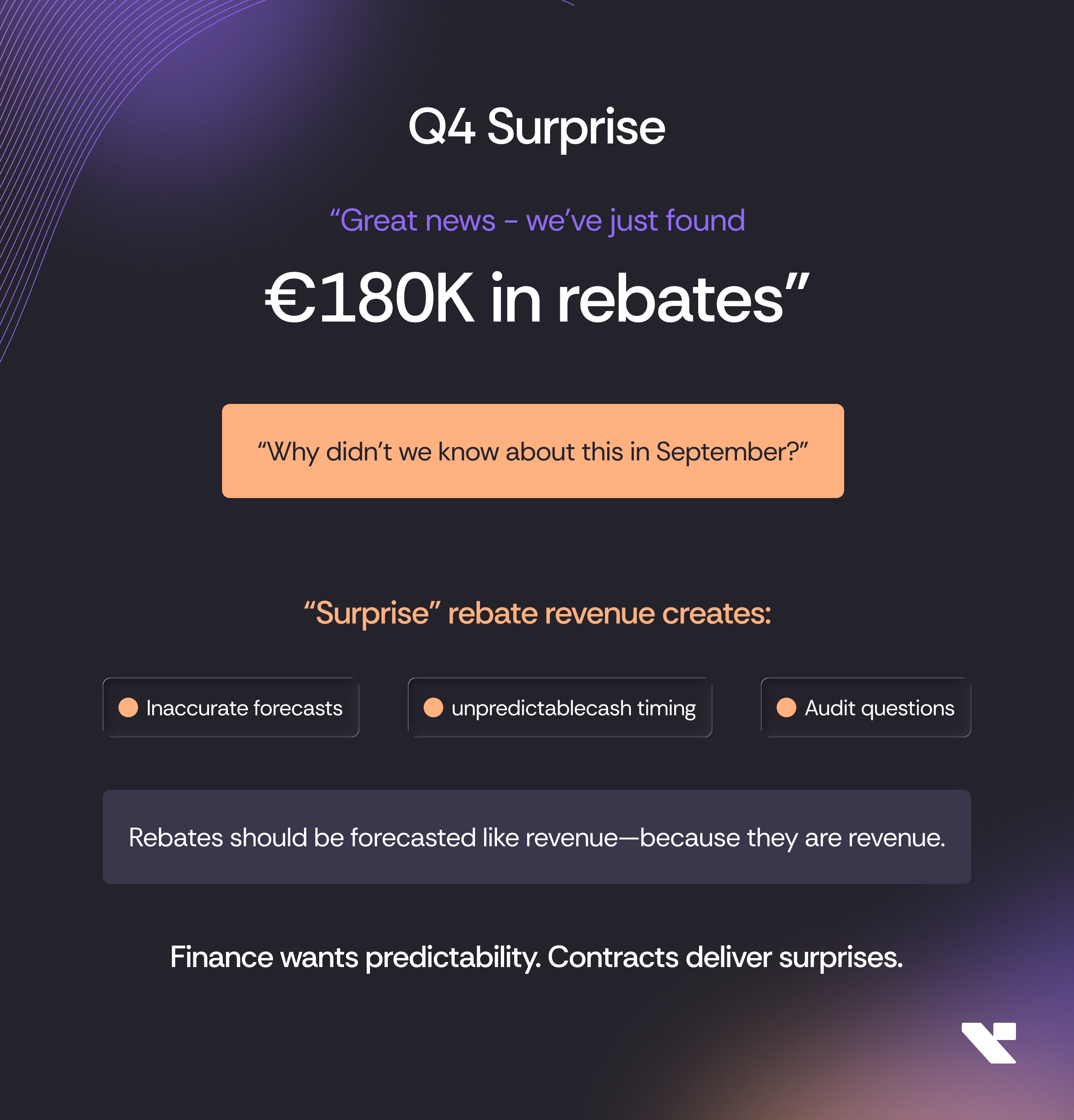
The Q4 Surprise Pattern
The typical cycle:
- January-September: Procurement tracks rebates loosely. Finance assumes minimal impact.
- October: Year-end review triggers threshold awareness.
- November: Claims start getting compiled.
- December: Rush of claim submissions before deadlines.
- Q1: Rebate payments arrive. Finance books unexpected income.
The CFO conversation:
"Why is our rebate income €180K this quarter when we forecasted €90K?"
"We hit some thresholds we didn't expect."
"How do I explain a 100% positive variance to the board?"
Positive variance sounds good. But unexplained variance - in either direction - undermines confidence in financial planning.
Why Surprise Revenue Is a Problem
Forecast Credibility
When actuals consistently surprise, forecasts lose meaning. Stakeholders stop trusting the numbers.
Cash Planning
Finance plans cash flows based on forecasts. Surprise rebate income disrupts working capital management.
Budget Distortion
If December rebates inflate current year results, next year's budget baseline is skewed. "Why can't you hit last year's numbers?" becomes an unfair question.
Audit Complexity
Large, unexpected income items draw auditor attention. Documentation becomes critical. Year-end scrambles create risk.
According to World Commerce & Contracting, contract management failures increasingly appear in audit findings - not just as operational issues but as governance failures.
The Root Cause: Reactive Tracking
Surprise revenue isn't about unexpected business performance. It's about tracking methodology.
Reactive Tracking:
- Check thresholds at year-end
- Calculate rebates due when claim windows open
- Submit claims based on deadline pressure
- Book income when payments arrive
Result: Finance learns about rebate income when it's already earned.
Proactive Tracking:
- Monitor threshold progress monthly
- Project year-end position based on run rate
- Update forecasts as thresholds approach
- Submit claims systematically
Result: Finance knows about expected rebate income while it's being earned.
Same rebates. Different visibility. Different planning capability.
What Continuous Tracking Looks Like
Monthly Threshold Report
- Current spend vs. each tier threshold
- Projected year-end position (based on run rate)
- Expected rebate income at current trajectory
Quarterly Forecast Update
- Updated projections based on actual performance
- Threshold acceleration opportunities identified
- Claim timing calendar
Finance Integration
- Rebate income forecast included in financial projections
- Accruals booked monthly (not annually)
- Variance analysis at supplier level
According to McKinsey research, organizations with connected contract and operational data capture significantly more value - partly through better forecasting and planning.
The Accrual Challenge
GAAP says you should accrue earned rebates. Most companies can't - because they don't know the number.
The problem:
- Rebate calculations require knowing threshold status
- Threshold status requires connecting purchases to contract terms
- Most systems don't make this connection
The result:
- Rebates booked when claimed (cash basis)
- Not accrued when earned (accrual basis)
- Financial statements don't reflect economic reality
The fix:
Systematic threshold tracking that produces accrual-ready data monthly.
"We earned €47K in rebates this month based on threshold achievement. Accrual entry attached."
That's financial discipline. That's what auditors want to see.
The Business Case: Predictable vs. Surprise
Scenario: €20M supplier spend, €400K annual rebate potential
Surprise Model:
- Forecast: €200K (conservative guess)
- Actual: €320K (discovered in Q4)
- Variance: +60%
- CFO confidence: Low
Continuous Model:
- Q1 forecast: €280K
- Q2 update: €310K (threshold approaching)
- Q3 update: €325K (threshold hit)
- Actual: €320K
- Variance: -1.5%
- CFO confidence: High
Same rebate income. Different planning quality. Different organizational trust.
Implementation Steps
- Map all rebate mechanisms across supplier contracts
- Establish monthly reporting of threshold progress
- Connect to financial forecasting process
- Implement monthly accruals for earned rebates
- Create variance analysis by supplier and mechanism
Timeline: 60-90 days to implement basic continuous tracking.
Investment: Primarily process and system connection - not new technology.
Return: Forecast accuracy, audit readiness, planning confidence.
How Does Your Company Forecast Earned Rebates?
If the answer is "we don't until we claim them" - your finance team is flying blind.
The rebate income is real. The question is whether you plan for it or discover it.
Great news - we just found €180K in rebates.
Why didn't we know about this in September?
That question shouldn't have to be asked.
Rebates should be forecasted like any other revenue stream - because that's what they are.