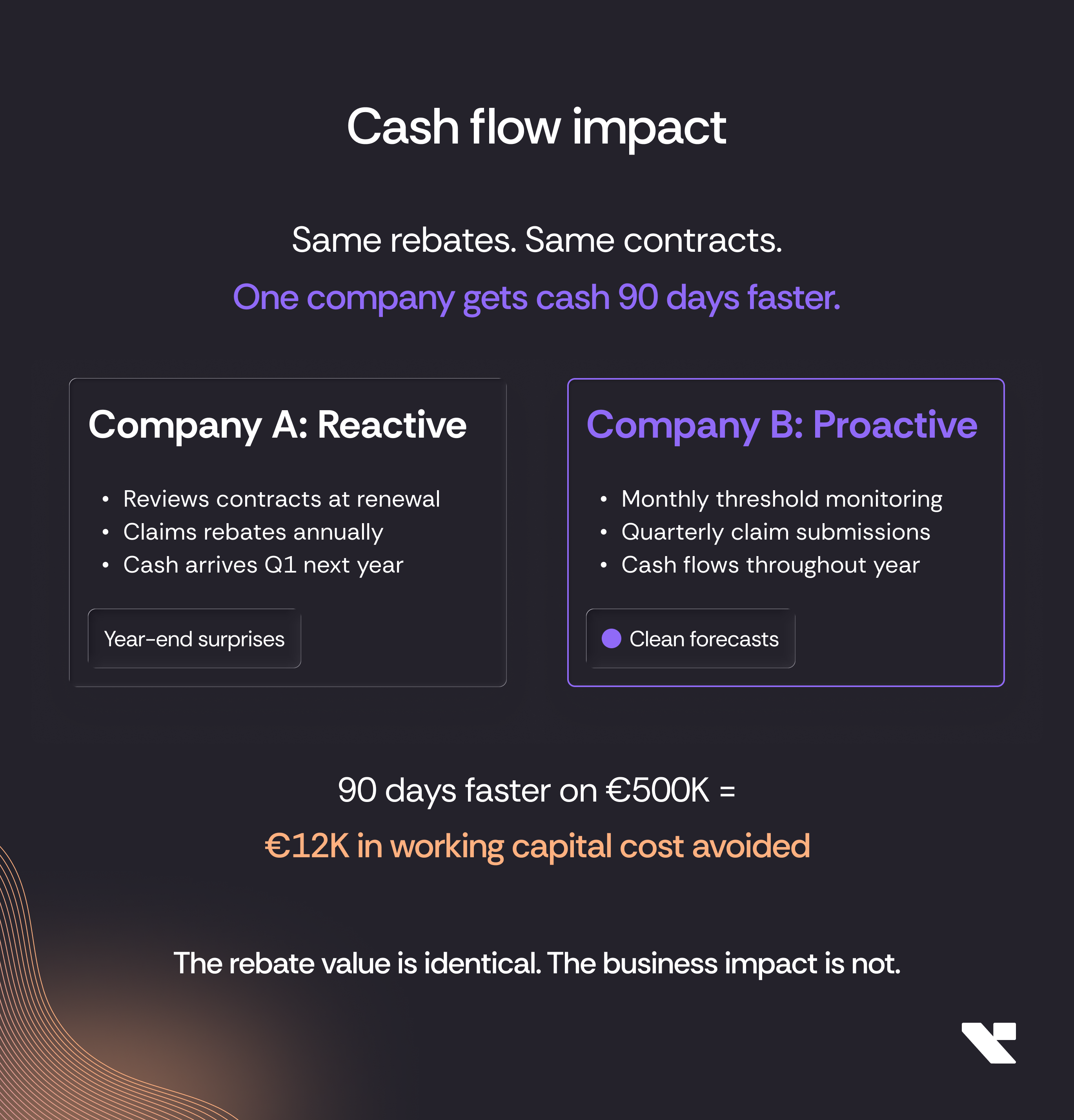
The Cash Flow Difference
Reactive Cash Flow Pattern:
- January-November: €0 rebate cash received
- December: Claims submitted for year
- January-February: Payments processed
- March: Cash arrives
Total annual rebates: €400K, received in a single Q1 lump.
Proactive Cash Flow Pattern:
- Q1: Claims for Q4 submitted → €100K received
- Q2: Claims for Q1 submitted → €95K received
- Q3: Claims for Q2 submitted → €105K received
- Q4: Claims for Q3 submitted → €100K received
Same €400K, but spread across the year.
The difference isn't the amount - it's the timing. And timing has financial value.
The Working Capital Impact
The math:
If you receive rebate cash 90 days earlier on average, you're financing €X less working capital.
Example: €400K annual rebates
- Reactive: Average collection 180 days after earning
- Proactive: Average collection 60 days after earning
- Difference: 120 days earlier
- Working capital saved: €400K × (120/365) × 5% = €6,575
Scale effect:
€2M in annual rebates × 120 days earlier × 5% cost of capital = €32,877 annual working capital benefit.
That's not the rebate itself - that's just the timing advantage.
According to McKinsey research, organizations with systematic incentive tracking don't just capture more value - they capture it faster.
Beyond Cash Timing: Other Proactive Benefits
Better Supplier Relationships
Quarterly claims mean quarterly touchpoints. You're engaging on performance, not just price.
Cleaner Forecasts
Continuous tracking produces continuous data. Finance can forecast with confidence.
Earlier Issue Detection
Monthly monitoring catches problems early. Threshold at risk? You know in Q2, not December.
Stronger Negotiating Position
Data in hand throughout the year. When renewal comes, you're not scrambling.
Proactive tracking isn't just about faster cash. It's about better contract management across all dimensions.
The Reactive Trap
Why do organizations stay reactive? Because reactive feels easier - until it isn't.
Reactive seems simpler:
- "We'll deal with it at year-end"
- "Claims are a once-a-year thing"
- "We don't have time for monthly tracking"
But reactive creates hidden costs:
- Year-end scramble consumes procurement bandwidth
- Rushed claims have documentation gaps
- Missed deadlines forfeit value
- Finance surprises create board-level questions
According to Industry research, 40% of contract value leakage stems from execution failures. Reactive approaches maximize the opportunity for those failures.
Making the Shift: Reactive to Proactive
Phase 1: Establish Monthly Visibility
- Identify all rebate mechanisms across suppliers
- Create threshold tracking dashboard
- Generate monthly status reports
Phase 2: Implement Quarterly Claims
- For suppliers with quarterly claim options: shift to quarterly
- For annual-only: prepare claims progressively
- Document as you go, not at year-end
Phase 3: Integrate with Finance
- Include rebate forecasts in financial projections
- Book monthly accruals
- Report claim pipeline regularly
Timeline: 90 days to shift from fully reactive to substantially proactive.
The Business Case: Reactive vs. Proactive
Scenario: €30M supplier spend, €900K annual rebate potential
Reactive Approach:
- Claims submitted annually
- Average cash timing: 180 days after earning
- Capture rate: 65% (some deadlines missed)
- Actual collected: €585K
Proactive Approach:
- Claims submitted quarterly
- Average cash timing: 60 days after earning
- Capture rate: 92% (systematic tracking)
- Actual collected: €828K
Direct value difference: €243K annually
Working capital benefit: Additional €15K-€20K
Same rebate structures. Different approach. €260K+ difference.
Implementation Checklist
- ☐ Map all incentive mechanisms across top 30 suppliers
- ☐ Identify which allow quarterly claims
- ☐ Create threshold tracking system/dashboard
- ☐ Establish monthly review cadence
- ☐ Shift quarterly-eligible claims to quarterly
- ☐ Build documentation progressively
- ☐ Integrate with finance forecasting
- ☐ Measure: capture rate, cash timing, forecast accuracy
Expected outcomes:
- 15-25% improvement in capture rate
- 60-90 days improvement in average cash timing
- Significant reduction in year-end scramble
When Did You Last Claim a Rebate?
If everything comes in once a year, calculate what that timing is costing you.
The rebate value is identical. The business impact is not.
Company B gets the same money 90 days faster. That's not negotiation skill. That's process discipline.
Same contracts. Same suppliers. Different approach.
One company manages cash. The other waits for it.
Which one are you?