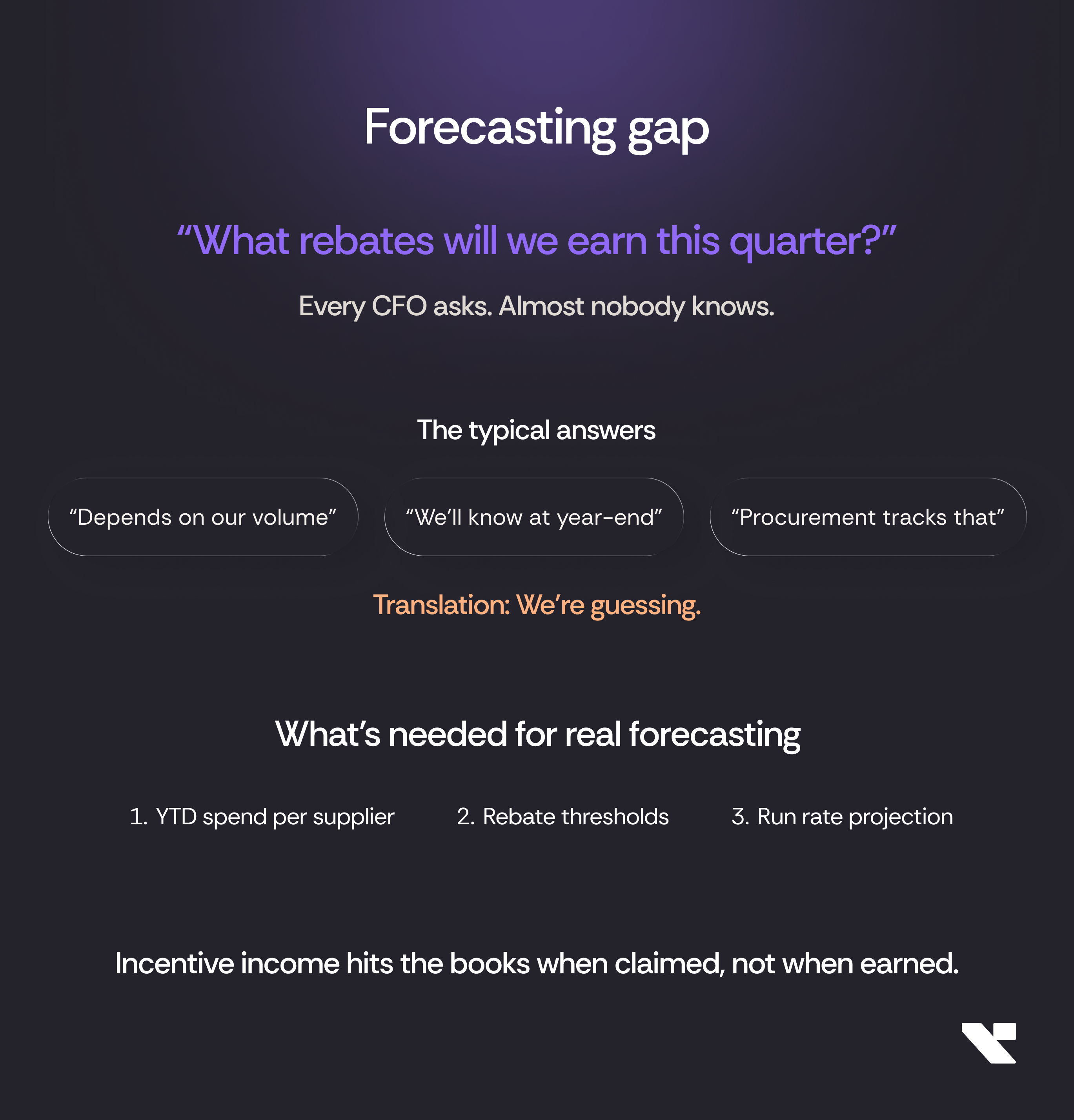
The Forecasting Gap
What gets forecasted well:
- Revenue (detailed by product, region, customer)
- Operating costs (by department, category)
- Capital expenditure (project-level)
- Headcount (by function)
What doesn't:
- Supplier rebates
- Volume incentives
- Early payment discounts
- Performance credits
Why the gap? Revenue and costs flow through standard systems. Incentives require connecting contract terms to operational data - which most organizations can't do.
According to PwC research, 90% of professionals struggle to locate contracts when needed. If you can't find the contract, you can't forecast the incentive.
Why Guessing Is the Default
Data Fragmentation
Spend data lives in ERP. Contract terms live in CLM. Claim history lives in spreadsheets. Threshold calculations require all three.
Calculation Complexity
Multi-tier rebates with different calculation periods, stacking rules, and claim windows. Too complex for quick estimates.
Ownership Gaps
Finance owns forecasting. Procurement owns contracts. Neither owns the connection.
Historical Patterns
"Last year we got about €200K" becomes the forecast. Based on memory, not analysis.
The result: Forecasts are conservative guesses, and actuals are annual surprises.
The GAAP Challenge
Accounting standards require accruing earned rebates. Most companies can't.
The requirement:
If you've earned a rebate (threshold achieved), you should recognize it when earned - not when claimed or paid.
The reality:
- Most companies don't know when thresholds are achieved
- Can't calculate earned amount until claim is prepared
- Book income when cash arrives, not when earned
The risk:
Financial statements don't reflect economic reality. Earned value is understated. Auditors increasingly focus on this gap.
According to World Commerce & Contracting, contract management failures increasingly appear in audit findings.
Building Real Incentive Forecasts
Step 1: Inventory All Mechanisms
- Volume rebates by supplier
- Growth incentives
- Early payment terms
- Performance credits
Step 2: Connect to Spend Data
- YTD spend per supplier
- Spend run rate
- Projected year-end total
Step 3: Calculate Threshold Position
- Current tier vs. next tier
- Distance to threshold
- Probability of achievement
Step 4: Project Incentive Value
- Expected rebate at current trajectory
- Upside if threshold acceleration
- Claim timing and cash receipt
The Monthly Forecast Cycle
Week 1: Data Collection
- Pull updated spend data from ERP
- Update threshold tracking dashboard
Week 2: Analysis
- Calculate current position vs. all thresholds
- Project year-end position
- Identify acceleration opportunities
Week 3: Forecast Update
- Update incentive forecast for finance
- Note changes from prior month
- Flag risks and opportunities
Week 4: Finance Integration
- Include in overall financial forecast
- Update accruals if appropriate
- Align with cash flow projections
The Business Case: Forecast vs. Guess
Scenario: €25M supplier spend, multiple incentive mechanisms
Guessing Approach:
- Annual forecast: "About €600K like last year"
- Actual: €840K (discovered in Q4)
- Variance: +40%
- Audit questions: Yes
Forecasting Approach:
- Q1: €700K forecast
- Q2: €780K (threshold approaching)
- Q3: €820K (threshold achieved)
- Actual: €840K
- Variance: +2.4%
- Audit questions: Minimal
Same incentive income. Different planning quality.
Ask Your Controller This Question
Are we accruing for earned-but-unclaimed rebates?
If not, why not?
The answer usually comes back to data: "We don't know how much we've earned until we claim it."
That's not an accounting problem. That's a tracking problem.
Fix the tracking, and the forecasting follows.
"What rebates will we earn this quarter?"
Every CFO asks. Almost nobody knows.
It's time to change that.
From Guessing to Knowing
Incentive forecasting requires:
- Knowing what mechanisms exist (contract data)
- Knowing current position (spend data)
- Connecting the two (systems integration)
- Updating regularly (process discipline)
The data exists in your organization. The question is whether you've connected it.
Every CFO asks: "What rebates will we earn this quarter?"
The answer should be specific, data-backed, and updated monthly.
Not "depends on volume" or "we'll know at year-end."
Real numbers. Real forecasts. Real confidence.