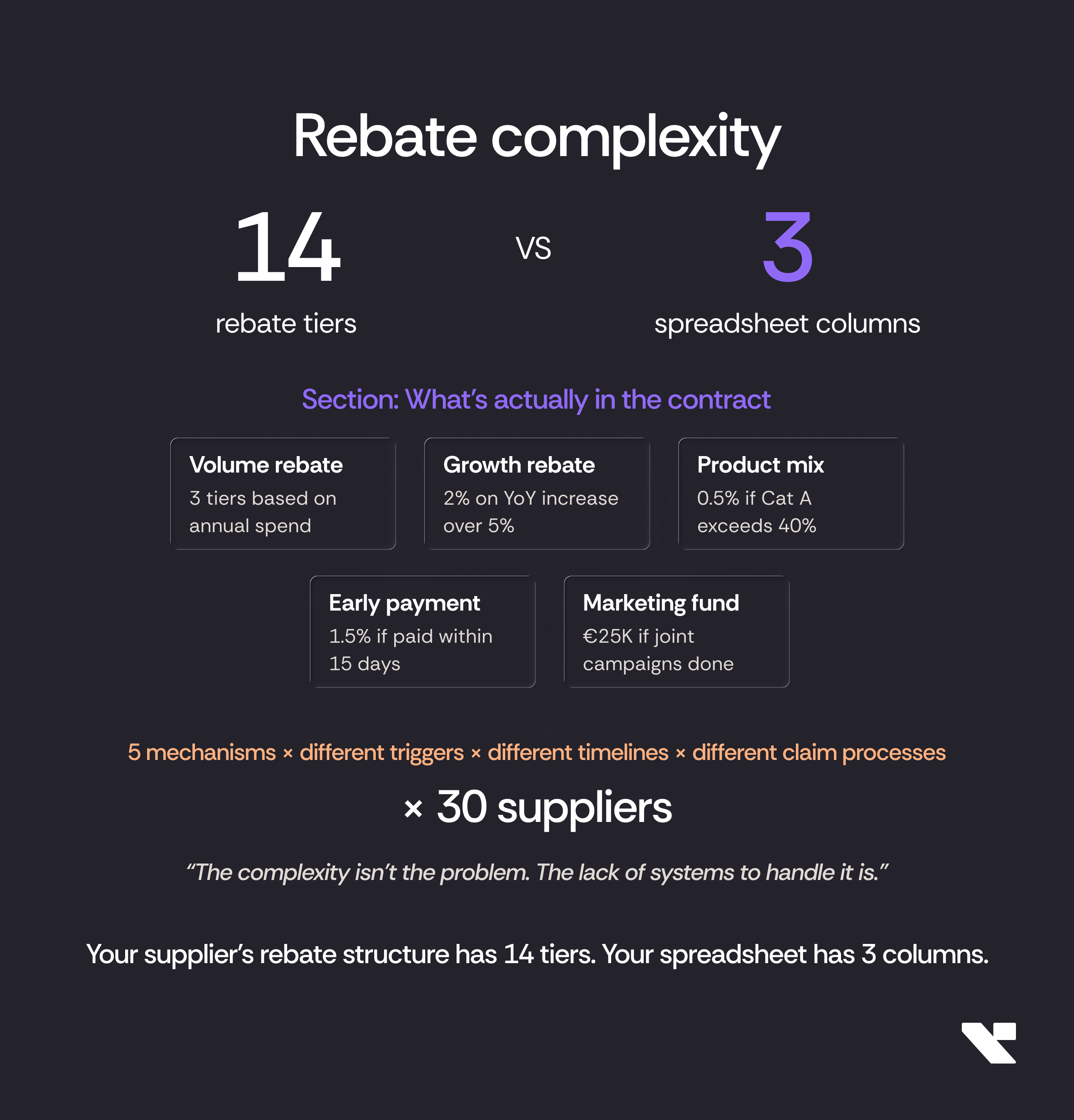
The Anatomy of a 'Simple' Supplier Agreement
Let's dissect what a typical "straightforward" supplier agreement actually contains.
Supplier: Industrial components, €2M annual spend
Volume Rebate Structure
- Tier 1: 0-€500K = 1.0%
- Tier 2: €500K-€1M = 1.5%
- Tier 3: €1M-€2M = 2.0%
- Tier 4: €2M+ = 2.5%
Calculated on trailing 12 months. Claimed quarterly. Deadline: 45 days after quarter end.
Growth Incentive
- YoY growth 5-10%: Additional 0.5%
- YoY growth 10-20%: Additional 1.0%
- YoY growth 20%+: Additional 1.5%
Calculated on calendar year. Claimed annually. Deadline: February 28.
Product Mix Bonus
- Category A exceeds 35% of total: 0.25% bonus
- Category A exceeds 45% of total: 0.50% bonus
Calculated on fiscal year. Claimed with Q4 volume rebate.
Early Payment Terms
- 2% discount if paid within 10 days
- Net 30 standard
Per invoice. No claim required - automatic if AP processes in time.
Marketing Development Fund
- €15K available for joint marketing activities
- Pre-approval required
- Claim within 60 days of activity completion
Total incentive mechanisms: 5
Distinct claim deadlines: 4
Calculation methodologies: 5
This is one supplier. This is considered "straightforward."
The Tracking Challenge: Why Spreadsheets Fail
Your spreadsheet has columns for: Supplier, Contract Value, Rebate %, Renewal Date.
Maybe a "Notes" column where someone typed "growth bonus available."
What the spreadsheet cannot track:
- Current progress toward each tier threshold
- Different calculation periods (calendar vs. fiscal vs. trailing)
- Multiple claim deadlines with different requirements
- Interactions between mechanisms (does growth bonus stack with volume?)
- Supporting documentation requirements per claim type
According to Industry research, spreadsheets "must be created and maintained manually by copying and pasting data from one spreadsheet to another, which makes searching, collaborating, and sharing extremely difficult."
The result:
- Volume rebate claimed (most visible)
- Growth incentive in many cases claimed (if someone remembers)
- Product mix bonus rarely claimed (too complex to track)
- Early payment discount inconsistent (AP doesn't know which suppliers qualify)
- MDF funds unused (nobody initiated activities)
On that €2M supplier, maximum available incentives will total €65K annually.
Typical capture rate with spreadsheet tracking: €35K-€40K.
€25K-€30K left unclaimed. One supplier. Every year.
The Interaction Problem: When Mechanisms Stack
Multi-tier rebate structures aren't just about tracking individual mechanisms. They're about understanding how mechanisms interact.
Stacking vs. Sequential
Does your growth incentive stack on top of volume rebate? Or replace it?
- Stacking: Volume rebate (2%) + Growth bonus (1%) = 3% total
- Sequential: Higher of volume rebate (2%) or growth bonus (1%) = 2% total
Different suppliers structure this differently. in many cases within the same supplier, different mechanisms follow different rules.
Threshold Dependencies
Some contracts make growth incentives contingent on hitting base volume:
"Growth bonus applies only if Tier 2 volume threshold achieved."
You grew 25% but didn't hit €500K? Growth bonus doesn't apply.
Product Mix Impact on Volume Tiers
Some contracts treat product categories differently for volume calculations:
"Category B purchases count at 50% toward volume thresholds."
Your €1M spend will only be €750K for rebate purposes.
These interactions are buried in contract language. They're not in your spreadsheet. They're in paragraph 4.3(b)(ii) of the agreement.
When's the last time someone read paragraph 4.3(b)(ii)?
The Timing Maze: Multiple Deadlines, Multiple Periods
Contract incentives operate on different clocks.
Your Supplier Portfolio will Include:
- Supplier A: Calendar year calculation, Q1 claim deadline
- Supplier B: Fiscal year calculation, 60 days after close
- Supplier C: Trailing 12-month, quarterly claims
- Supplier D: Calendar year, but growth bonus on fiscal year
- Supplier E: Quarterly volume, annual growth, perpetual MDF
According to Industry research, "A spreadsheet can flag a renewal date but cannot track shifting vendor risks, surface spending leakage, or monitor compliance obligations."
The timing complexity creates multiple failure modes:
- Claims submitted too early (insufficient data)
- Claims submitted too late (window expired)
- Wrong calculation period used
- Documentation gathered for wrong timeframe
One missed deadline. One confused calculation period. Thousands in forfeited value.
The Documentation Burden: Different Requirements Per Mechanism
Even when you track thresholds and meet deadlines, you still need documentation.
Volume Rebate Claim Requires:
- Summary of qualifying purchases by period
- PO numbers and invoice references
- Signed claim form
Growth Incentive Claim Requires:
- Prior year baseline calculation
- Current year total calculation
- Growth percentage verification
- Tier qualification confirmation
Product Mix Bonus Requires:
- Category breakdown by spend
- Percentage calculations
- Product classification verification
MDF Claim Requires:
- Pre-approval documentation
- Activity completion evidence
- Expense receipts and invoices
- Performance metrics (if applicable)
Four different mechanisms. Four different documentation packages. Four different compilation efforts.
Multiply by 30 suppliers.
This is why procurement teams spend weeks on quarterly reconciliation. Not because they're slow - because the complexity is genuinely overwhelming without systematic support.
What Systematic Tracking Actually Requires
Managing multi-tier rebate complexity requires more than better spreadsheets. It requires a fundamentally different approach.
Structured Incentive Data
Every mechanism extracted from contract language and stored as structured data:
- Threshold tiers and percentages
- Calculation periods and methodologies
- Claim deadlines and requirements
- Interaction rules and dependencies
Real-Time Progress Tracking
Connected to purchasing data:
- Current status vs. each threshold
- Projected year-end position
- Category breakdown tracking
- Growth rate monitoring
Automated Alerts
Proactive notifications:
- Approaching thresholds (10%, 5%, 1% away)
- Upcoming claim deadlines (30, 14, 14 days)
- Documentation requirements due
- Interaction triggers activated
Documentation Management
Systematic preparation:
- Requirements checklist per mechanism
- Data compilation automation
- Historical claim records
- Audit trail maintenance
According to McKinsey research, organizations with systematic contract tracking capture 90-95% of value compared to 55-65% relying on manual processes.
On complex multi-tier structures, that gap is even wider.
The Business Case: Complexity Premium
Scenario: Distribution company, €25M supplier spend, 45 major contracts with multi-tier structures
Average Available Incentives Per Contract:
- Volume rebates: 2.5% average = €625K
- Growth incentives: 0.5% average = €125K
- Product mix bonuses: 0.25% average = €62.5K
- Early payment discounts: 0.75% average = €187.5K
- MDF and other funds: €150K
Total Available: €1.15M
Typical Capture Rates:
- Manual tracking: 55-65% capture = €630K-€750K claimed
- Systematic tracking: 90-95% capture = €1.03M-€1.09M claimed
Value Gap: €300K-€400K annually
That's not theoretical. That's the documented difference between organizations that systematically manage incentive complexity versus those that track "the main rebates" and hope for the best.
World Commerce & Contracting data shows best performers capture 3% more value than laggards - on complex incentive structures, that percentage translates to significant absolute dollars.
Pick Your Most Complex Supplier Agreement
Here's a test for your organization:
Pick your most complex supplier agreement. Count the distinct incentive mechanisms.
Volume rebates. Growth bonuses. Product mix incentives. Early payment discounts. Marketing funds. Performance bonuses. Loyalty rewards.
Now ask: Who's tracking each one?
If the answer is "procurement tracks volume, AP handles early pay, marketing uses the MDF when they remember" - you have a coordination problem.
If the answer is "it's all in a spreadsheet that Sarah maintains" - you have a single-point-of-failure problem.
If the answer is "I'm not sure we track all of them" - you have a visibility problem.
The complexity isn't going away. Suppliers design multi-tier structures because they work - for the supplier. They make it harder to claim, harder to track, harder to maximize.
Your choice is whether to match that complexity with systematic capability - or continue leaving money on the table.
How many tiers? How many deadlines? How many mechanisms?
Now: how many are you actually capturing?