The Scale of the Problem: Why Spreadsheets Cost More Than You Think
The numbers from leading research firms are stark:
According to World Commerce & Contracting and Deloitte research, the average company loses 19% of contract value through mismanagement. Best-in-class organizations limit this to 3-7%, while underperformers lose over 25%.
McKinsey's 2025 research on procurement value leakage confirms these findings: contract value leakage quietly drains significant value every year - not from poor negotiations, but from what happens after the ink dries: maverick spend, missed rebates, unclaimed volume discounts, and unmanaged renewals.
For a company with €20 million in supplier contracts, even the conservative end of that range represents €1.8 million in annual leakage - much of it from disconnected systems and manual processes.
Deloitte and DocuSign's 2025 Digital Agreement Management Study quantified the global impact: poor contract management costs businesses $2 trillion per year globally - expected to rise to $2.3 trillion by 2030.
Aberdeen Research found that automation can reduce administrative costs related to contracts by 25% to 30%, while best-in-class companies achieve 56% higher contract renewal rates compared to their peers. Yet most organizations continue relying on Excel because "it works well enough."
Time Savings with Contract Intelligence
Research from leading consulting firms quantifies what proper contract intelligence delivers:
| Process | Time Savings | Source |
|---|---|---|
| Manual bonus/rebate administration | ~50% reduction | Aberdeen: "Contracting cycles cut in half" |
| Negotiation preparation | ~40% reduction | BCG: "Time on negotiations declined 30%+" |
| Search & versioning | ~60% reduction | Forrester: "60% improvement in efficiency" |
Beyond time savings, proper rebate management delivers a minimum 3% bonus optimization - value recovery that's impossible with spreadsheet tracking. McKinsey confirms organizations recover 3-5% of contract value through systematic contract intelligence.
The problem isn't that spreadsheets are inherently bad. The problem is that they were never designed for contract management or rebate tracking:
- No real-time connection to purchasing data
- No automated threshold monitoring
- No alerts when claim windows approach
- No visibility into earned-but-unclaimed value
A spreadsheet is a static snapshot. Contract value requires dynamic monitoring.
Where Spreadsheet Tracking Actually Fails
Let's be specific about the failure modes. These aren't edge cases - they're patterns we see in every organization that hasn't moved beyond manual tracking.
The Threshold Blindness Problem
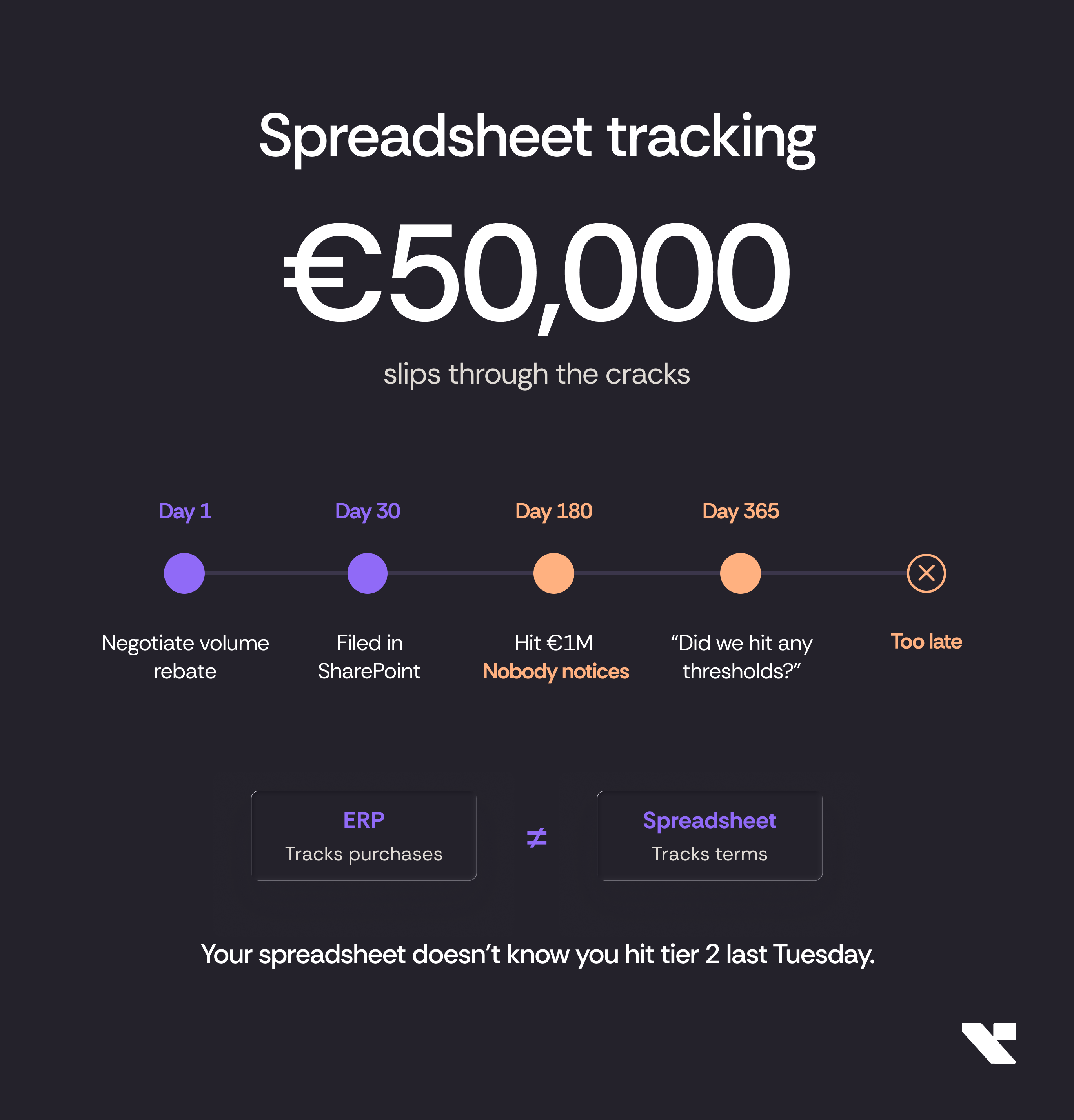
Your supplier contract says: "2% rebate at €500K annual spend, 3% at €1M."
Your spreadsheet contains these numbers. Your ERP contains your actual spending. These systems don't talk to each other.
The result:
- You hit €1M on October 15th
- Nobody knows until the year-end reconciliation
- By then, you've missed three months of claiming at the higher tier
- Or worse - you never realize you qualified at all
According to Industry research, spreadsheets "must be created and maintained manually by copying and pasting data from one spreadsheet to another, which makes searching, collaborating, and sharing extremely difficult and time-consuming."
The Version Control Nightmare
Contract amended? Someone needs to update the spreadsheet.
But which spreadsheet? The one on the shared drive? The one Sarah keeps for "her suppliers"? The version that was emailed to finance last quarter?
Industry research highlights that spreadsheets "is easily shared or modified without proper tracking, which can lead to version control issues and accidental data loss."
The Single Point of Failure
Every spreadsheet depends on the individual who built it. What happens when that person goes on vacation? Changes roles? Leaves the company?
Industry research notes: "A spreadsheet can flag a renewal date but cannot track shifting vendor risks, surface spending leakage, or monitor compliance obligations."
The Scalability Cliff
Spreadsheet tracking works when you have 10 contracts. It strains at 50. It breaks at 200.
Industry research identifies this pattern: "Once the number of contracts managed per year reaches hundreds or more, organizations reach a point at which spreadsheet-based contract management no longer suffices."
The Hidden Costs Nobody Measures
The direct cost of missed rebates is visible - once you find it. But spreadsheet-based tracking creates indirect costs that never appear on any report.
Time Cost: The Manual Reconciliation Tax
How does your team currently calculate earned incentives? If the answer involves:
- Exporting PO data to Excel
- Opening contract PDFs to find threshold terms
- Manually matching purchases to rebate tiers
- Cross-referencing across multiple spreadsheets
- Emailing results to finance for verification
Then your team is spending dozens of hours per quarter on work that adds no value beyond answering a question the system should answer automatically.
Aberdeen Research quantifies this: organizations with manual contract processes spend 40% more time on administrative tasks compared to those with integrated systems.
Error Cost: The Confidence Gap
When finance asks "are you sure?", what's the honest answer?
Spreadsheet calculations depend on data being entered correctly, formulas working as intended, all amendments being captured, and no cells being accidentally overwritten.
One wrong formula. One missed update. One overwritten cell. And suddenly your €47,000 rebate calculation becomes €34,000 - or €0.
Opportunity Cost: Negotiations Without Data
When you renegotiate a contract, what data do you bring?
Your supplier knows exactly what they paid you. They have integrated systems tracking every rebate, every threshold, every claim.
You have. a spreadsheet that someone updated six months ago.
That's not a negotiation. That's theater.
The Data Silo Problem: Why ERP Alone Isn't the Answer
organizations without systematic tracking believe the answer is better ERP utilization. "Everything's in SAP - we just need to use it better."
But ERPs were designed to track transactions, not contract obligations.
According to Industry research, "Without integration, legal, finance, and procurement teams operate on separate datasets. This creates data duplication, inconsistencies, and blind spots."
Your ERP knows:
- Every purchase order
- Every invoice
- Every payment
Your ERP doesn't know:
- Rebate threshold structures
- Claim window deadlines
- Volume tier triggers
- Growth bonus conditions
- Early payment discount terms
The data exists - in two places. The connection doesn't exist anywhere.
Industry research highlights that "vendor, item, and PO data can drift across systems without clean interfaces, causing mismatches and manual reconciliations."
Manual reconciliation isn't a solution. It's a symptom of the underlying problem: disconnected systems.
What Contract Intelligence Actually Looks Like
The alternative to spreadsheet chaos isn't "better spreadsheets." It's a fundamentally different approach to contract data.
Structured Contract Data
Every contract's key terms - pricing, incentives, thresholds, deadlines - extracted into structured data fields. Not buried in PDF paragraph 14.3.
When a new contract is signed, its obligations are automatically catalogued. When an amendment is executed, the data updates. When a threshold approaches, the system knows.
Connected to Operational Reality
Contract terms linked to actual purchasing data. Real-time visibility into:
- Current spend vs. rebate thresholds
- Days remaining until claim windows close
- Earned value vs. claimed value
- Performance against contract targets
The question "did we hit tier 2?" has an immediate, accurate answer - not a three-day research project.
Proactive Alerts, Not Reactive Discovery
Instead of discovering missed thresholds at year-end, receive alerts when:
- You're within 10% of hitting the next tier
- A claim window opens (or is about to close)
- Volume growth qualifies you for additional rebates
- Early payment terms is captured
Reactive tracking finds problems after the money is lost. Proactive tracking captures value before it expires.
The Business Case: From Spreadsheet to System
Let's be concrete about the economics.
Scenario: Distribution company, €30M annual supplier spend, 80 major contracts
Current State (Spreadsheet-based tracking):
- Average missed thresholds per year: 6-10
- Estimated uncaptured value: €100,000-€200,000 annually
- Staff time on manual tracking/reconciliation: 300+ hours/year
- Data confidence level: "We think so?"
After implementing systematic contract intelligence:
- Missed thresholds: Near zero
- Value capture rate: 95%+ of available incentives
- Staff time redirected to strategic work
- Data confidence level: Auditable, real-time accuracy
Gartner forecasts that implementing AI-based contract analytics will reduce human work for contract assessment by 50% by 2024. The technology exists. The question is whether your organization will adopt it - or continue losing value to spreadsheet limitations.
The Test: Can You Answer These Questions?
Pull up your contract management system - whatever it is - right now.
- What is your current YTD spend with your top 5 suppliers?
- Which rebate thresholds are you within 10% of hitting?
- What claim windows close in the next 30 days?
- How much earned-but-unclaimed value exists across your contract portfolio?
If answering any of these questions requires:
- Opening Excel
- Searching through PDFs
- Emailing someone in finance
- Saying "I'd have to check"
Then your contract management system isn't a system. It's a collection of files pretending to be one.
Stop the Silent Leakage
According to McKinsey research, organizations that move from manual to systematic contract management typically recover 3-5% of contract value through improved visibility and enforcement.
On €30M in contracts, that's €900K-€1.5M in recovered value - from thresholds that would otherwise have been missed, claims that would otherwise have expired, and opportunities that would otherwise have remained invisible.
€50K in our scenario wasn't stolen. It wasn't negotiated away. It simply vanished in the gap between what was purchased and what was tracked.
Your contract portfolio almost certainly contains similar stories. Thresholds crossed but never claimed. Tiers reached but never recognized. Value earned but never captured.
Pull your current YTD spend on your top supplier. Now find the rebate tiers in their contract.
How long did that take?
If the answer is "more than 60 seconds," you're at risk.
And that risk has a number attached to it.