For CFOs and Procurement leaders, this represents a critical gap in contract value management that directly impacts the bottom line.
Why Auditors Are Looking
Contract rebates have become an audit focus area for several reasons:
Materiality
For companies with significant supplier spend, rebates can represent material income. Material items require proper controls.
Complexity
Multi-tier structures with different calculation periods and conditional triggers create opportunities for errors.
Timing Issues
Rebates earned in one period, claimed in another, paid in a third. Proper cutoff and recognition matter.
Revenue Recognition Standards
ASC 606 and similar standards have increased scrutiny of variable consideration - including supplier incentives.
According to World Commerce & Contracting, contract failures are increasingly appearing in audit findings - not just as operational issues but as governance failures.
Common Audit Findings
Inconsistent Accrual Methodology
Different approaches for different suppliers. No documented policy. Estimates that can't be supported.
Missing Documentation
Calculations without supporting data. Claims without audit trail. Threshold achievements without verification.
Period Cutoff Issues
Rebates booked when received rather than when earned. Year-end recognition of value earned throughout the year.
Control Gaps
No segregation of duties. No approval workflows. No reconciliation procedures.
Contract Term Uncertainty
Inability to quickly verify what terms apply. Reliance on individual knowledge rather than documented records.
The Documentation Requirement
What auditors want to see:
For Each Claim:
- Contract reference with relevant terms highlighted
- Calculation showing how amount was derived
- Supporting data (spend reports, threshold verification)
- Approval documentation
- Claim submission record
- Payment receipt reconciliation
For Overall Process:
- Written policy for rebate recognition
- Accrual methodology documentation
- Control procedures and responsibilities
- Reconciliation processes
The question: How long would it take you to produce this documentation for your last rebate claim?
If the answer is "days," you have audit risk.
The Control Framework
Preventive Controls:
- Standardized contract term extraction
- Systematic threshold monitoring
- Documented calculation methodologies
- Approval workflows for claims
Detective Controls:
- Monthly reconciliation of claims vs. payments
- Variance analysis vs. forecast
- Period-over-period comparison
- Independent review of significant claims
Documentation Controls:
- Audit trail for all calculations
- Supporting data retention
- Approval records
- Exception documentation
According to McKinsey research, organizations with systematic contract management have significantly lower compliance risk.
The Spreadsheet Problem
Spreadsheet-based tracking creates specific audit vulnerabilities:
Version Control
Which version is authoritative? What changed between versions? Who made changes?
Formula Integrity
Are formulas correct? Have they been accidentally modified? Can they be verified?
Data Sources
Where did input data come from? Is it current? Can it be traced back?
Access Control
Who can modify the spreadsheet? Is access logged? Are changes tracked?
Auditors know these vulnerabilities. Spreadsheet-based processes automatically draw more scrutiny.
Building Audit Readiness
- Document your policy
Write down how you recognize rebates, when you accrue, how you calculate - Standardize calculations
Same methodology across suppliers. Same documentation standards. - Create audit trail
Every calculation traceable to source data and contract terms - Implement controls
Approval workflows. Reconciliation procedures. Segregation of duties. - Test regularly
Internal review of claims before external audit. Catch issues early.
Timeline: 60-90 days to establish basic audit-ready processes.
Investment: Process documentation and control implementation.
Return: Clean audits, reduced risk, better controls.
The Business Case: Risk vs. Investment
Cost of Audit Issues:
- Finding documentation: €10K-€50K in staff time
- Auditor extra work: €20K-€100K in fees
- Control weaknesses: Management attention, board questions
- Restatements: Significant if material errors found
Cost of Prevention:
- Process documentation: 40-80 hours
- Control implementation: Ongoing discipline
- System investment: Variable
The math is clear: Prevention costs a fraction of cure.
And beyond audit, good controls drive better value capture.
Pull Your Last Audit Workpaper
For rebate accruals: How long would it take to recreate that calculation from source documents?
If the answer is hours or days, that's your risk exposure.
If you don't have a workpaper for rebate accruals, that's an even bigger exposure.
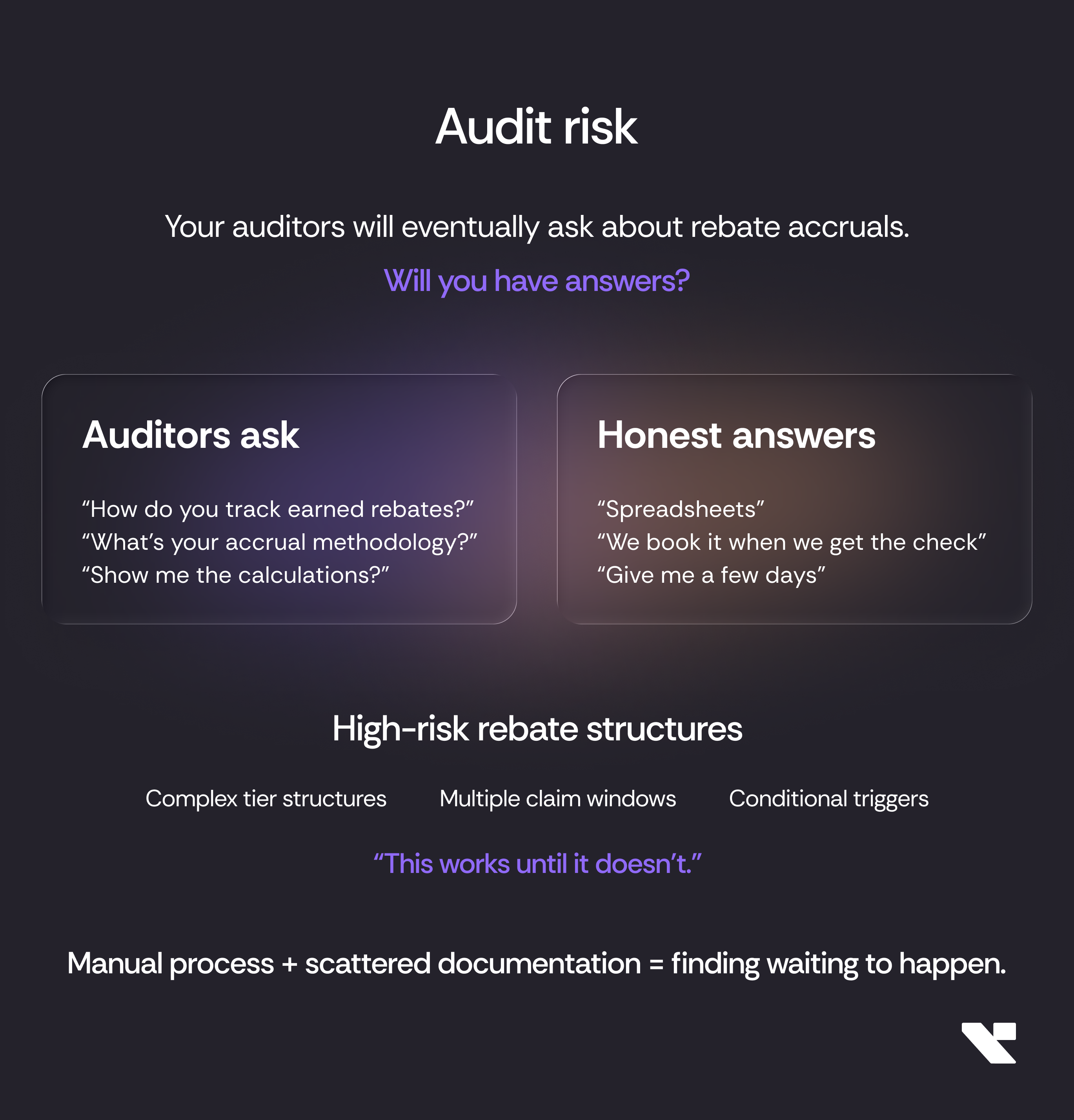
Your auditors will eventually ask about rebate accruals.
Will you have answers - or a scramble?
The audit risk hiding in your vendor agreements is real. The fix isn't more spreadsheets. It's systematic tracking that auditors can follow.
Build it now. Not during audit season.