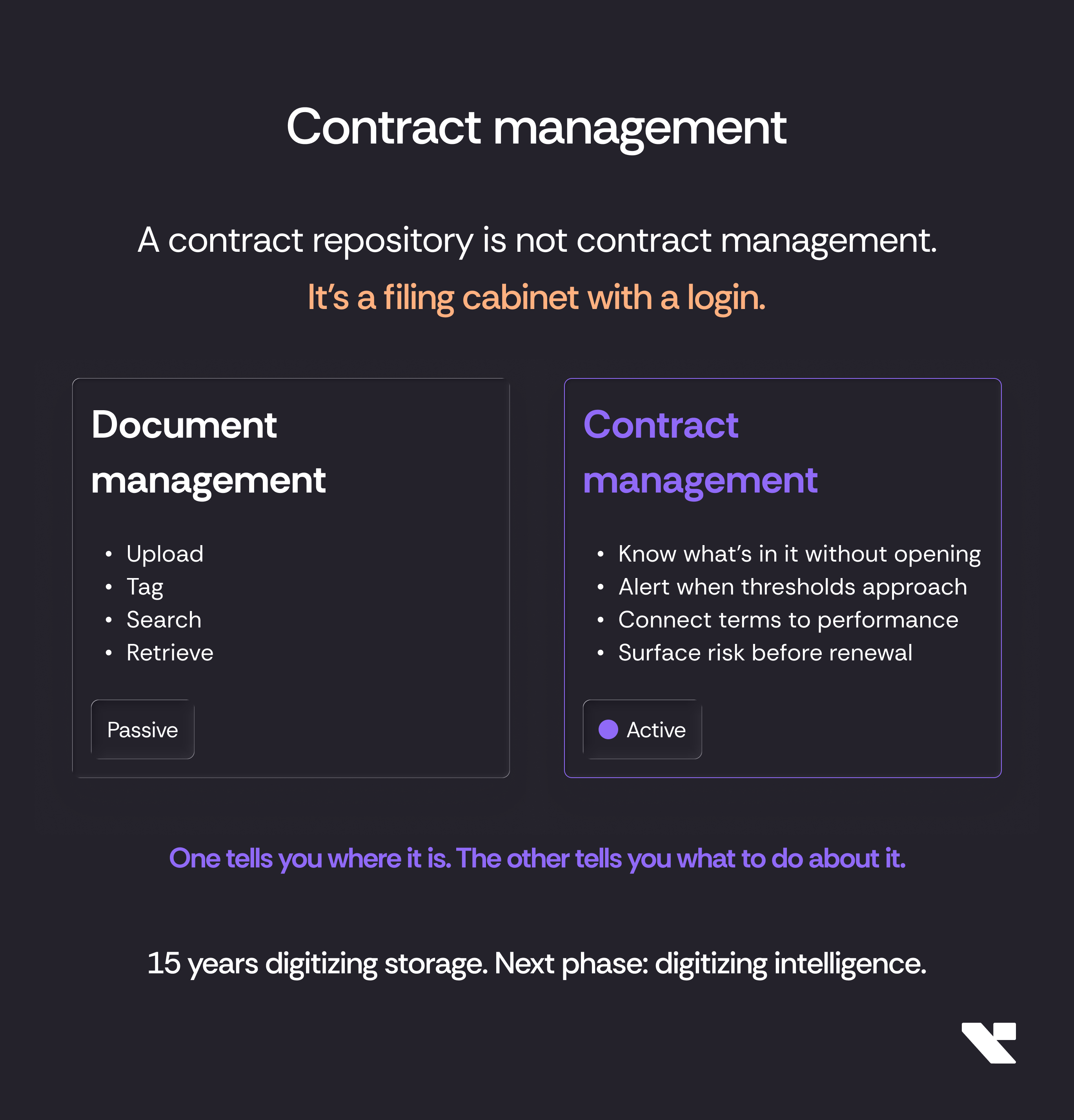
The Storage vs. Management Gap
For CFOs and Procurement leaders, understanding this challenge is critical to protecting contract value.
What storage gives you:
- Contracts findable (eventually)
- Basic metadata (parties, dates, value)
- Expiration tracking
- Version history
What storage doesn't give you:
- Understanding of contract terms at scale
- Connection to operational data
- Proactive alerts on value opportunities
- Portfolio-level insights
According to PwC research, 90% of professionals struggle to locate contracts when needed. But locating is just the beginning. Understanding, connecting, and acting is where value lives.
The Test: Can Your System Answer?
Open your contract system. Pick a random supplier. Without opening the PDF, can you tell me:
- Rebate tiers?
- Claim deadlines?
- YTD performance against thresholds?
- Earned-but-unclaimed value?
- Upcoming obligation deadlines?
If you can't: You have storage - not management.
If you can: You have contract intelligence.
The difference determines whether your contracts are documents or assets.
From Passive to Active
Passive State
Contracts sit in repository. Opened only at renewal. Terms forgotten between signings. Value leaks silently.
Active State
Contract terms extracted and structured. Connected to operational data. Proactive alerts when action needed. Continuous value monitoring.
The transformation requires:
- Term extraction - Pull key terms into structured data
- Data connection - Link to ERP/spend systems
- Alert creation - Trigger notifications on events
- Action workflows - Guide users to capture value
What Proactive Management Looks Like
Instead of: "Where is that contract?"
You get: "Here's what you need to know about that supplier."
Example dashboard view:
- Current tier: Tier 2 (€1M-€2M)
- YTD spend: €1.85M
- Next tier: €2M (€150K away)
- Tier benefit: Additional 0.5%
- Claim window: Opens Jan 1, closes Feb 28
- Earned unclaimed: €47K
- Action needed: Submit Q4 claim by Dec 31
That's contract intelligence. The contract becomes an active asset, not a passive file.
The Industry Evolution
15 years of digitizing storage:
- Paper → Shared drives
- Shared drives → CLM repositories
- CLM repositories → Cloud CLM
The next phase: digitizing intelligence
- Static PDFs → Structured data
- Manual search → Proactive surfacing
- Document metrics → Value metrics
- Repository → Intelligence platform
According to Forrester, contract management is evolving "from use-case-driven solutions to enterprise contract management platforms" - platforms that connect contracts to business outcomes.
The Business Case: Storage vs. Intelligence
Scenario: €30M supplier spend, 100 active contracts
Storage approach:
- Contracts stored and searchable
- Terms known only when PDF opened
- Capture rate: 60-70%
- Annual leakage: €270K-€360K
Intelligence approach:
- Terms extracted and structured
- Connected to spend data
- Proactive alerts and workflows
- Capture rate: 90-95%
- Annual leakage: €45K-€90K
Value difference: €225K-€270K annually
Same contracts. Different approach. Different outcomes.
Making the Transition
- Assess current state - What does your CLM actually do? What gaps exist?
- Prioritize contracts - Which 20% drive 80% of potential value?
- Extract key terms - Pull incentive structures into structured data
- Connect to ERP - Link contract terms to spend data
- Build workflows - Create alerts and action triggers
- Measure outcomes - Track capture rate improvement
Timeline: 60-90 days for initial transformation of priority contracts.
Storage or Management?
Your contract system:
Can it tell you rebate tiers without opening the PDF? Management.
Do you have to search and read? Storage.
Can it alert you when thresholds approach? Management.
Do you discover missed opportunities at year-end? Storage.
A contract repository is not contract management. It's a filing cabinet with a login.
The industry spent 15 years digitizing contract storage. The next phase is digitizing contract intelligence.
Which phase is your organization in?