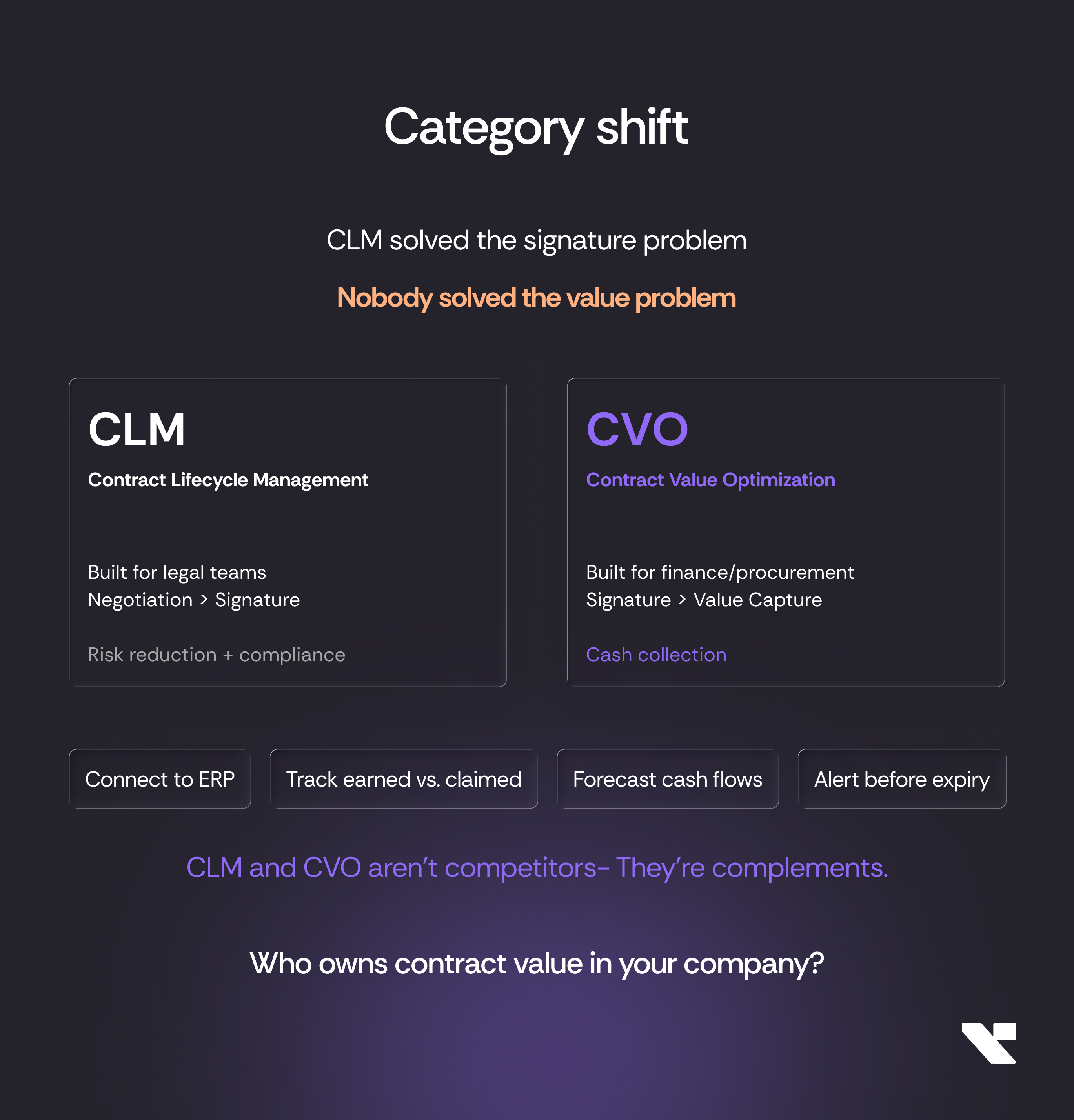
What CLM Was Built For
CLM origin story:
Legal teams drowning in contracts. Manual processes. Version chaos. Slow approvals.
CLM solution:
- Template libraries
- Clause banks
- Redlining workflows
- Approval automation
- E-signature integration
- Central repository
CLM success metric: Time from draft to signature.
This is valuable. Legal efficiency matters. But CLM was never designed to answer: "Are we capturing the value we negotiated?"
That's a different question requiring different capabilities.
The Post-Signature Gap
What happens after signature in most organizations:
- Contract uploaded to CLM repository
- Basic metadata entered (parties, dates, value)
- Expiration alert set
- Legal moves to next deal
What doesn't happen:
- Incentive terms extracted and tracked
- Thresholds monitored against spend
- Claim windows calendared
- Value capture measured
According to World Commerce & Contracting, 19% of contract value leaks through poor management. Most of that leakage occurs post-signature.
CLM solved pre-signature. The post-signature problem remains.
Contract Value Optimization Defined
CVO is a different category with different focus:
Different User
CLM: Legal and contract administrators
CVO: Finance, procurement, operations
Different Problem
CLM: Risk reduction, compliance, efficiency
CVO: Value capture, incentive tracking, cash optimization
Different Outcome
CLM: Compliance, audit trail
CVO: Cash collected, capture rate
Different Metrics
CLM: Contract cycle time, compliance rate
CVO: Available vs. claimed value, forecast accuracy
CVO Capabilities
Connecting contract terms to ERP transactions
Spend data linked to rebate thresholds. Automatic calculation of earned value.
Tracking earned vs. claimed value
Real-time visibility into what you're owed vs. what you've collected.
Forecasting incentive cash flows
Projected rebate income based on spend trajectory and threshold proximity.
Alerting before value expires
Proactive notifications on claim windows, approaching thresholds, expiring rights.
Portfolio-level analysis
Cross-supplier, cross-category insights. Patterns and opportunities.
According to McKinsey, organizations with these capabilities capture 3-5% more value than those without.
CLM and CVO: Complements, Not Competitors
CLM excels at:
- Contract creation and drafting
- Negotiation workflows
- Approval processes
- E-signature
- Compliance documentation
CVO excels at:
- Post-signature value tracking
- Operational data connection
- Incentive management
- Value forecasting
- Cash optimization
The ideal state:
CLM manages the document lifecycle. CVO manages the value lifecycle. Both connected, each doing what they do best.
They're not competitors. They're complements.
The Organizational Question
Who owns contract value in your company?
Legal owns the document.
Procurement owns the relationship.
Finance owns the cash.
Operations owns the performance.
But who owns the value?
In most organizations: nobody explicitly.
That's why value leaks. That's why CLM alone isn't enough.
CVO requires someone to own the answer to: "Are we capturing the value we negotiated?"
If no one owns it, that's the job description for your next hire - or your next system investment.
The Business Case: Adding CVO to CLM
Scenario: Organization with mature CLM, €40M supplier spend
Current state (CLM only):
- Contracts drafted efficiently
- Signature time reduced 40%
- Compliance excellent
- Post-signature value capture: 65%
With CVO added:
- All CLM benefits retained
- Contract terms connected to spend
- Incentives actively tracked
- Post-signature value capture: 92%
On €1.6M available incentives (4% of spend):
65% capture = €1.04M
92% capture = €1.47M
Difference: €430K annually
The Next Evolution
CLM solved the signature problem.
Contracts get created, negotiated, and signed more efficiently than ever.
The value problem remains unsolved.
Value leaks post-signature. Incentives go unclaimed. Rights expire unused.
The next evolution isn't better CLM.
It's Contract Value Optimization - a category focused on what matters most: capturing the value you negotiated.
Who owns contract value in your company?
If no one does, that's where to start.