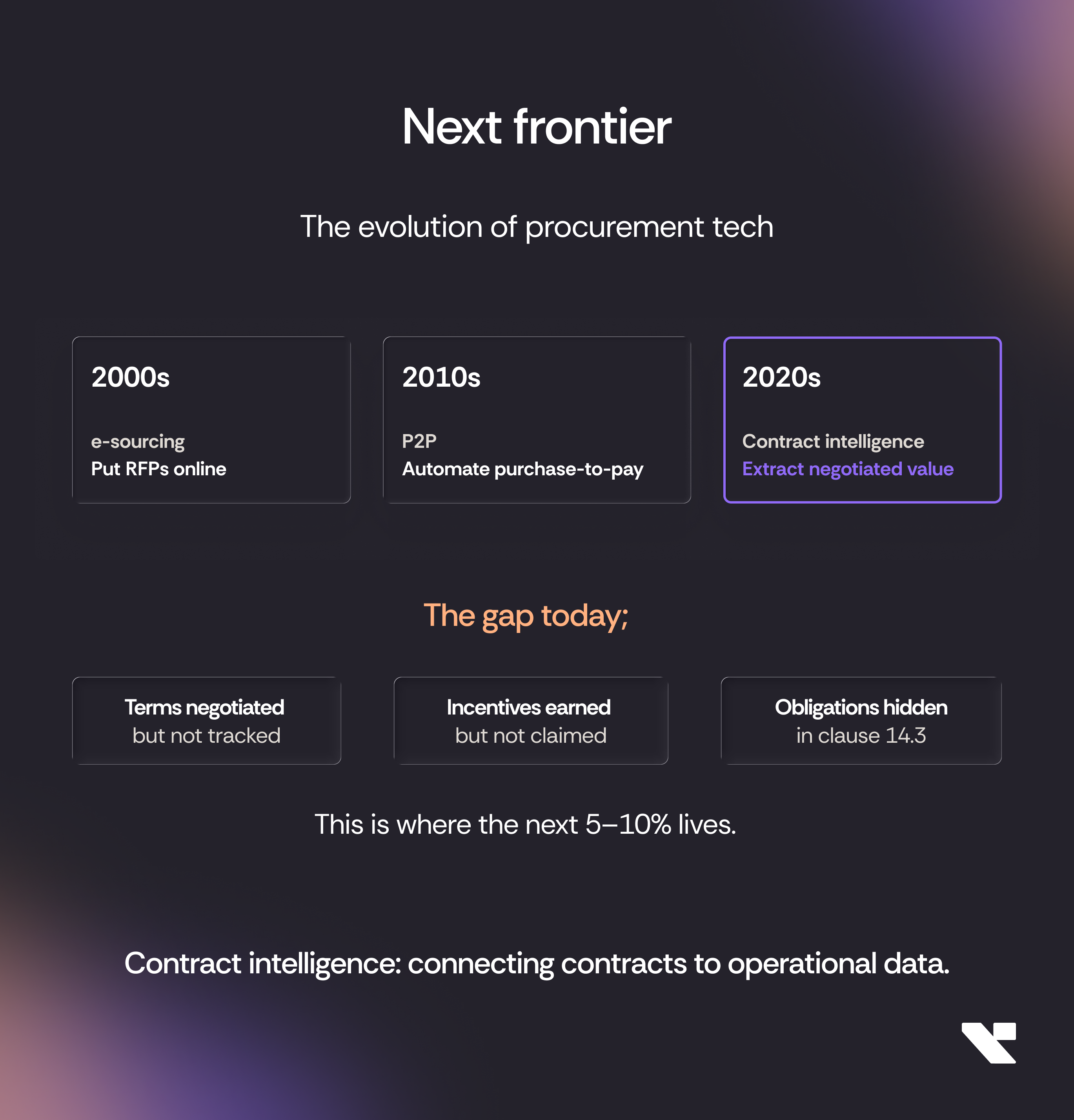
The Three Waves of Procurement Tech
Wave 1: E-Sourcing (2000s)
Problem: RFQ processes were manual and slow
Solution: Online platforms for bid collection and comparison
Result: Faster sourcing cycles, broader supplier participation
Wave 2: P2P Automation (2010s)
Problem: Purchase requisitions, approvals, and payments were manual
Solution: End-to-end workflow automation
Result: Efficiency gains, control improvements
Wave 3: Contract Intelligence (2020s)
Problem: Negotiated value isn't captured post-signature
Solution: Connect contracts to operational data
Result: Value capture, not just value negotiation
According to Forrester, modern CLM needs to be "a bridge between strategy and reality, not just a document workflow tool."
Where Current Investment Goes
Typical procurement tech budget allocation:
- Sourcing platforms: 25-30%
- P2P systems: 40-50%
- Supplier management: 15-20%
- Post-signature contract value: 5-10%
The imbalance:
Most investment goes to getting better deals and processing transactions efficiently. Minimal investment goes to capturing the value from deals already made.
According to World Commerce & Contracting, organizations lose 19% of contract value through poor management - a number that dwarfs the efficiency gains from better sourcing.
What percentage of your procurement tech budget goes to post-signature contract value?
If the answer is close to zero, you're optimizing the wrong part of the cycle.
The Post-Signature Value Gap
Pre-signature: Intense focus
- Negotiation teams engaged
- Legal review thorough
- Finance modeling complete
- Terms optimized
Post-signature: Silence
- Contract filed in repository
- Terms forgotten until renewal
- Incentives tracked loosely (if at all)
- Value leaks continuously
The gap:
- Terms negotiated but not tracked
- Incentives earned but not claimed
- Obligations hidden in clause 14.3
- Rights expired unused
Contract intelligence closes this gap - not by storing contracts better, but by connecting them to operational reality.
What Contract Intelligence Enables
Threshold Visibility
Real-time view of where you stand vs. all rebate tiers. Not quarterly reconciliation - continuous monitoring.
Proactive Alerts
Notifications when claim windows open, thresholds approach, deadlines near. Action triggers, not just data storage.
Performance Connection
Contract SLAs linked to actual delivery data. Remedy rights triggered automatically when performance falls short.
Portfolio Analysis
Cross-supplier, cross-category insights. Pattern recognition. Opportunity identification.
According to McKinsey research, organizations with systematic contract intelligence capture 3-5% more value than those without.
The Technology Evolution
CLM 1.0: Document Management
Store contracts. Search by metadata. Track expirations.
CLM 2.0: Workflow Automation
Drafting templates. Approval workflows. E-signature integration.
Contract Intelligence: Value Extraction
Term extraction and structuring. Connection to operational data. Proactive value surfacing. AI-enabled analysis.
The shift:
From managing documents to extracting value. From storing contracts to activating them.
According to Gartner, AI-based contract analytics will reduce human work for contract assessment by 50% - freeing resources for value capture rather than document management.
Where the Next 5-10% Lives
Scenario: €50M supplier spend, typical contract structures
Current state (traditional approach):
- Sourcing savings: 2-3% captured
- P2P efficiency: Process cost reduced
- Contract value: 65% of available captured
With contract intelligence:
- Sourcing savings: 2-3% (unchanged - already optimized)
- P2P efficiency: (unchanged - already automated)
- Contract value: 92% of available captured
The math:
If total incentives equal 5% of spend (€2.5M), moving from 65% to 92% capture means €675K additional value annually.
That's real money. That's where the next 5-10% lives.
Implementation Approach
- Assess current state
What contracts exist? What terms matter? What's being captured? - Prioritize high-value contracts
Focus on top 20% of suppliers that drive 80% of value - Extract and structure terms
Pull incentive mechanisms into trackable data - Connect to operational data
Link contract terms to ERP spend data - Build proactive workflows
Alerts, tasks, claim processes - Scale across portfolio
Extend to remaining contracts over time
Timeline: 90-180 days for initial high-value implementation.
The Investment Question
What percentage of your procurement tech budget goes to post-signature contract value?
If the answer is close to zero, ask why.
Sourcing is optimized. Purchasing is automated. Contract value is the last frontier.
The technology exists. The ROI is clear. The only question is timing.
Procurement digitized sourcing. Then purchasing. Contract value is next.
The organizations that move first will capture the 5-10% their competitors leave behind.