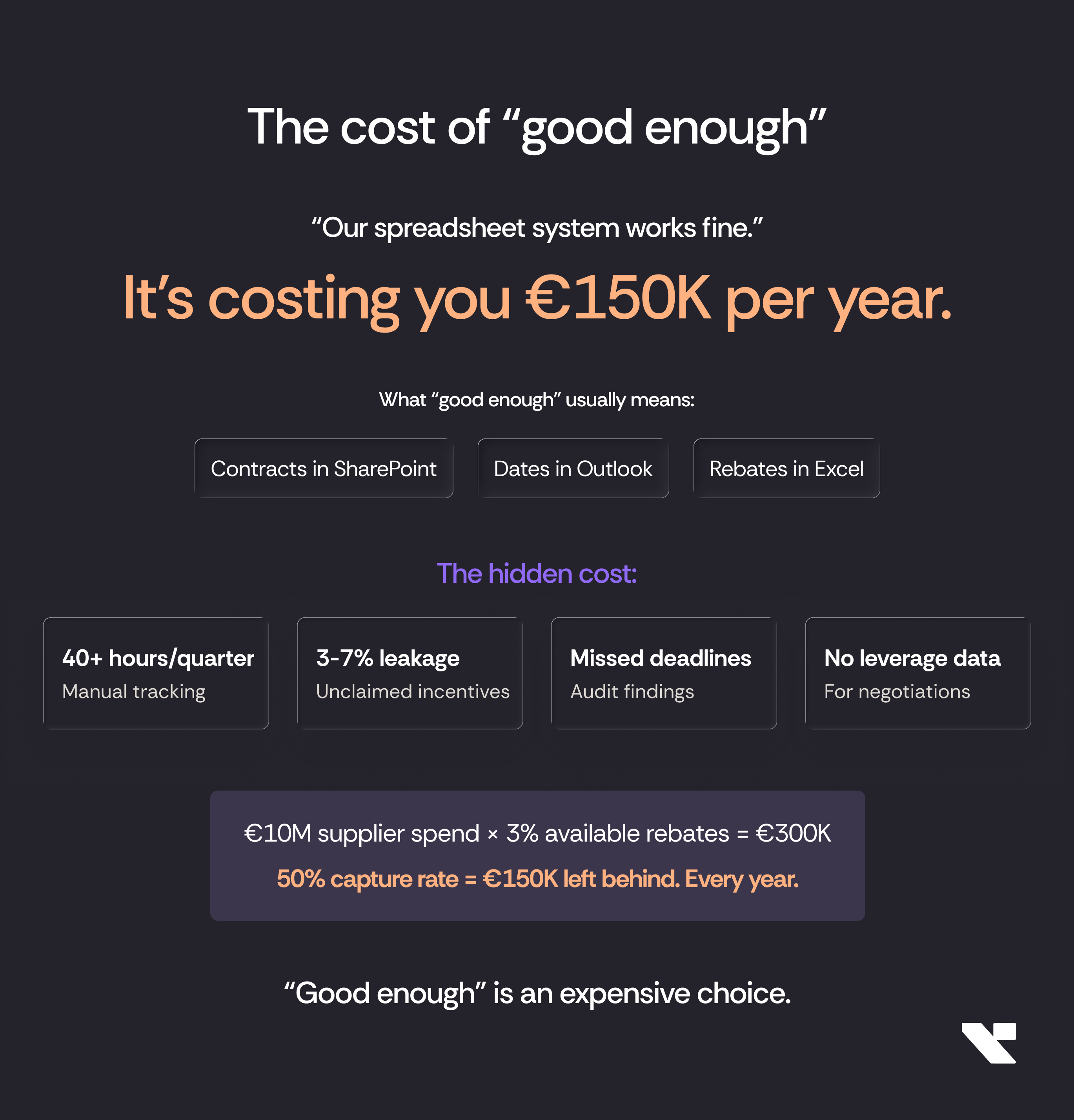
For CFOs and Finance Directors, the real cost of "good enough" contract management isn't visible on any dashboard. It's the €150K in rebates that never get claimed. The 400 hours spent maintaining spreadsheets that should be automated. The negotiating leverage you don't have because you can't prove your claim history.
Procurement leaders know this intuitively - but without the data, "good enough" persists.
The True Cost of 'Good Enough'
What CFOs and Procurement leaders need to understand:
Scenario: Company with €10M supplier spend, standard rebate structures
Available rebates: 3% average = €300K available annually
"Good enough" capture rate: 50% = €150K claimed
Value left behind: €150K annually
Every. Single. Year.
That's not a one-time miss. That's an annual tax on "good enough."
According to World Commerce & Contracting, the average company loses 9% of contract value through poor management. "Good enough" isn't good enough.
Where 'Good Enough' Fails
Threshold Blindness
You hit €980K against a €1M tier. Nobody noticed until February. Tier 2 bonus: missed.
Deadline Drift
Someone set a calendar reminder. That person changed roles. The reminder fired. Nobody knew what to do with it.
Documentation Gaps
Claim due in 30 days. Documentation requires 40 hours to compile. Deadline missed or claim reduced.
Knowledge Loss
The person who understood the contract terms left. The spreadsheet formulas they built? Broken. The institutional knowledge? Gone.
Negotiation Weakness
Renewal time arrives. "What did we capture last term?" "I'd have to check." That's not leverage. That's weakness.
The Time Tax
Hours spent on "good enough" processes:
- Quarterly rebate calculations: 20-30 hours
- Year-end claim preparation: 40-60 hours
- Contract term lookups: 5-10 hours/month
- Renewal preparation: 20-40 hours per major supplier
- Audit documentation: Variable (typically crisis mode)
Total: 200-400 hours annually
At fully-loaded cost of €75/hour: €15K-€30K in labor just to maintain "good enough."
That's not doing anything strategic. That's just keeping the spreadsheets running.
Add the €150K in leakage, and "good enough" costs €165K-€180K annually.
The Risk Accumulation
Audit Risk
Spreadsheet-based tracking lacks audit trail. When auditors ask about rebate accruals, how long does it take to produce documentation?
Compliance Risk
Contract obligations that aren't tracked are obligations that may not be met. Both yours and the supplier's.
Continuity Risk
Key person dependency. When they leave, "good enough" becomes "not working at all."
Opportunity Risk
Every missed threshold, every expired right, every unclaimed incentive - compounding losses that never appear on any report.
"Good enough" feels safe. It's not. It's just slow-motion value destruction.
The Calculation: What You're Choosing
When you choose "good enough," you're choosing:
- 2-5% value leakage on available incentives
- 200-400 hours of manual work annually
- Elevated audit and compliance risk
- Weak negotiating position at renewal
- No visibility into earned-but-unclaimed value
The alternative requires investment in:
- Better systems
- Process documentation
- Data integration
- Training and change management
The ROI math is clear:
Investment in systematic contract management typically pays back 3-5x in first year through improved capture rate alone - before considering time savings, risk reduction, and negotiation leverage.
What 'Good' Actually Looks Like
Good contract management:
- Contract terms extracted and structured
- Connected to operational data
- Thresholds monitored continuously
- Alerts on approaching deadlines
- Claims prepared systematically
- Capture rate tracked and improved
- Audit trail maintained automatically
Result:
- 90-95% capture rate (vs. 50-65% with "good enough")
- 90% reduction in manual tracking time
- Clean audits
- Data-backed negotiations
- No key-person dependency
According to McKinsey, organizations with systematic tracking capture 3-5% more contract value - that's the difference between "good enough" and actually good.
The Decision Framework
Calculate your rebate leakage:
Total rebates available minus total claimed.
If you can't calculate it, assume it's at least 30%.
Now multiply by your total spend subject to rebates.
That's what "good enough" costs.
Questions to answer:
- What's our current capture rate?
- How much time do we spend on manual tracking?
- What's the last deadline we missed?
- What audit findings have we had?
- What data do we bring to negotiations?
If you can't answer these quickly and accurately - that's your diagnostic.
'Good Enough' Is Expensive
"Our spreadsheet system works fine."
Does it? Have you calculated the leakage?
"We'd know if we were missing something."
Would you? Missed thresholds don't send notifications.
"It's not a priority right now."
The leakage continues whether it's a priority or not.
Calculate your rebate leakage.
Total rebates available minus total claimed.
If you can't calculate it, that's exactly the problem.
If you can, and it's significant - "good enough" is costing more than you think.
"Good enough" isn't. It's just expensive mediocrity disguised as pragmatism.