For CFOs and Procurement leaders, this represents a critical gap in contract value management that directly impacts the bottom line.
The Post-Signature Black Hole
The moment a contract is signed, organizational attention evaporates.
According to Deloitte research, the "hidden value" in post-signature management - avoiding unnecessary auto-renewals, missed incentives, and unexploited rights - represents one of the largest opportunities for value capture in contract management.
Yet most organizations treat signature as the finish line rather than the starting gun.
The typical contract lifecycle looks like this:
- Pre-signature: Intense focus. Multiple stakeholders. Legal review. Finance modeling. Procurement negotiation.
- Signature: Celebration. Deal closed. Value "captured."
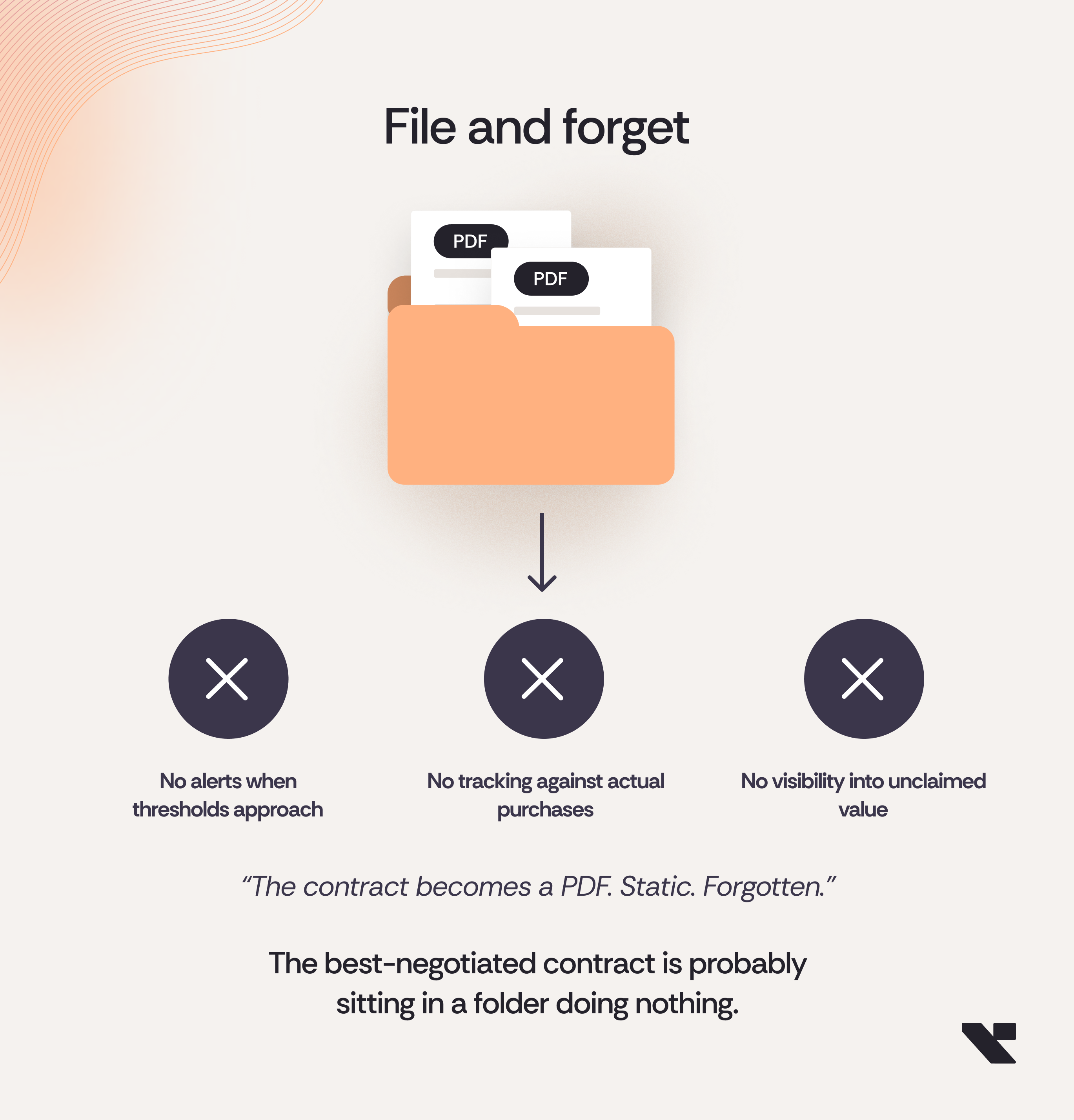
- Post-signature: Silence. The PDF goes into a folder. The folder goes into a system. The system is never opened again.
World Commerce & Contracting has repeatedly found that organizations lose around 19% of annual contract value through poor contract management - with the majority of that leakage occurring after signature, not before.
The problem isn't the negotiation. The problem is what happens next.
Where Value Disappears After Signature
Let's be specific about the failure modes. These aren't theoretical - they're patterns we see in every organization that treats contracts as "file and forget" documents.
Unclaimed Rebates and Incentives
Your contract includes a 2.5% volume rebate at €1M annual spend. You hit €1.2M.
Did you claim the rebate? Does anyone know?
According to Industry research, 40% of contract value leakage stems from process and follow-up failures - not from the initial negotiated deal.
The rebate was negotiated. The rebate was earned. The rebate was never claimed. Because the contract is sitting in a folder, and nobody is watching.
Auto-Renewal Traps
Your SaaS contract auto-renews in 90 days unless you provide written notice 60 days before.
Who's tracking that? Is there a calendar reminder? Did someone set one three years ago when the contract was signed? Is that person still with the company?
Research that approximately half of vendors with auto-renewal provisions do not send advance notice. They're not required to remind you. They're simply waiting for your cancellation window to close.
Unused Rights and Protections
Your contract includes:
- Price benchmarking rights after 12 months
- Termination for convenience with 90 days notice
- Performance remedies if SLAs fall below 99.5%
Have you ever used any of these? Do you even remember they exist?
Rights that aren't exercised are rights that don't exist. And rights buried in PDF paragraph 14.3 are rights nobody will ever exercise.
Knowledge Loss Through Turnover
The person who negotiated the contract knew all the nuances. The pricing model. The escalation paths. The informal agreements that never made it to paper.
That person left 18 months ago.
Now the contract is just a PDF. The institutional knowledge is gone. And the next renewal starts from zero.
The Economics of Neglect
Let's quantify what "file and forget" actually costs.
Scenario: Mid-sized company, €15M annual supplier spend, 120 active contracts
Typical "file and forget" losses:
- Unclaimed rebates: 2-3% of qualifying spend = €150K-€225K annually
- Auto-renewal surprises: 5-10 contracts × average €10K overpayment = €50K-€100K
- Unused price protection: 1-2% of spend that could have been benchmarked = €75K-€150K
- Missed performance remedies: SLA credits never claimed = €25K-€50K
Total annual leakage: €300K-€525K
That's not a worst-case scenario. That's the normal operating cost of treating contracts as documents rather than assets.
McKinsey research confirms that organizations typically lose 5-40% of contract value through ineffective post-signature management. The 3-5% we're describing is actually conservative.
The irony? You spent months negotiating these terms. Then you stopped paying attention the moment the signature dried.
Why Traditional CLM Doesn't Solve This
Many organizations have invested in Contract Lifecycle Management (CLM) systems. These help with:
- Document storage and search
- Template management
- Approval workflows
- E-signature integration
This is genuine progress. But CLM systems are designed for pre-signature efficiency - getting contracts drafted, reviewed, and signed faster.
They're not designed for post-signature value capture.
Forrester now describes modern CLM as needing to be "a bridge between strategy and reality, not just a document workflow tool."
A CLM system can tell you:
- Where the contract is stored
- When it expires
- Who approved it
A CLM system typically can't tell you:
- Whether you're hitting volume thresholds
- How much rebate you've earned but not claimed
- Whether supplier performance triggers remedy clauses
- What your spend trend means for the next negotiation
Document management is not value management.
What Active Contract Management Looks Like
The alternative to "file and forget" is treating contracts as living financial assets that require continuous attention.
Obligation Tracking
Every contractual obligation - yours and the supplier's - extracted, catalogued, and monitored.
- Rebate claim windows tracked with automatic alerts
- Auto-renewal dates flagged 120, 90, 60 days in advance
- Price review rights scheduled and assigned to owners
- Performance thresholds monitored against actual data
Connection to Operational Reality
Contract terms linked to actual spending, actual performance, actual outcomes.
Instead of "we think we're close to the threshold," you know exactly where you stand - in real time.
Proactive Workflow Triggers
When conditions change, actions happen:
- Spend hits 90% of rebate threshold → alert to push additional purchases
- SLA falls below target → remedy claim workflow initiated
- Renewal window approaching → negotiation prep package generated
Institutional Memory
Everything captured in the system - not in people's heads.
When someone leaves, the knowledge stays. When someone new joins, the context is available. When renewal comes, you're not starting from scratch.
PwC research shows that 90% of professionals struggle to locate contracts when needed. Active contract management means never having to search - the information finds you when you need it.
The Organizational Shift Required
Moving from "file and forget" to active contract management isn't just a technology change. It's an organizational mindset shift.
From Document Ownership to Value Ownership
Traditionally, Legal "owns" contracts. They draft them, review them, approve them.
But Legal's job ends at signature. Nobody owns the post-signature value capture.
The shift: designate explicit owners for contract value - people accountable for ensuring every dollar of negotiated value actually gets captured.
From Renewal-Driven to Continuous
Most organizations only look at contracts when they're about to expire. That's backwards.
The shift: treat contract management as a continuous function, not a periodic event. Monthly value reviews. Quarterly threshold checks. Ongoing performance monitoring.
From Reactive to Proactive
Currently, problems are discovered when they can't be fixed - missed deadlines, triggered auto-renewals, forfeited rebates.
The shift: systems that surface issues before they become problems, with enough lead time to take action.
KPMG and WorldCC research shows that almost 90% of organizations still operate with ineffective and fragmented contracting processes. The organizations that break this pattern gain measurable competitive advantage.
The Business Case: Active vs. Passive Management
Passive Contract Management (File and Forget):
- Contracts stored in CLM/SharePoint
- Renewal dates tracked (in many cases)
- Value capture dependent on individual memory
- Typical value leakage: 5-10% of contract value
Active Contract Management:
- Obligations extracted and monitored
- Connected to operational data
- Proactive alerts and workflows
- Typical value capture: 95%+ of available value
The math on €15M supplier spend:
- Passive approach: €750K-€1.5M leaked annually
- Active approach: €150K-€300K leaked annually
- Delta: €600K-€1.2M recovered value
That's not a projection. That's the documented difference between organizations that treat contracts as documents versus those that treat them as assets.
When Was the Last Time Someone Opened That Contract?
Here's a simple test for your organization:
When was the last time someone in your company opened a vendor contract that wasn't up for renewal?
If the answer is "never," you have a file-and-forget problem.
If the answer is "I don't know," you definitely have a file-and-forget problem.
If the answer is "last week, to check a rebate threshold," you're ahead of 90% of organizations.
Your contracts contain:
- Rebates you've earned but never claimed
- Rights you negotiated but never exercised
- Protections you paid for but never invoked
- Value that's leaking while the PDF sits in a folder
The best-negotiated contract in your company is probably sitting in a folder doing nothing.
Find it. Open it. Ask: what value have we captured since signature?
If you can't answer that question, you're leaving money on the table.
Every day that contract sits untouched is another day of silent value leakage.